
Font size
Background and font color
Images
Text scoring
Regular version of the site
Inr
Federal State Budgetary Institution of Science Institute for Nuclear Research of the Russian Academy of Sciences

+7-495-850-42-01
+7-495-850-42-01
Request a call
Email
inr@inr.ru
The address
Moscow, V-312, Prospekt 60-letiya Oktyabrya, 7a
Working hours
Mon. – Fri.: с 9:00 до 18:00
Request a call
Подать заявку
About
  • About the Institute
  • Directorate
  • Manadgement Department
  • Academic Council
History
  • History of the Institute
  • Outstanding scientists and founders of the institute
  • Anniversaries and memorable dates
Scientific activity
  • Research directions
  • Installations
  • Applied Research
    • Technologies
    • Patents
    • Projects
    • Cooperation
  • Dissertation Council
    • General information
    • Composition of the council
    • Defense of dissertations
    • Statistics
  • Council of Young Scientists
  • Conferences
  • Awards
Divisions
  • Department of High Energy Leptons and Neutrino Astrophysics
  • Accelerator complex department
  • Department of High Energy Physics
  • Department of Experimental Physics
  • Department of Theoretical Physics
  • Laboratory of High Energy Neutrino Astrophysics
  • Laboratory of Neutron Research
  • Laboratory of Medical Physics
  • Atomic Nucleus Laboratory
  • Laboratory of Photonuclear Reactions
  • Laboratory for Big Data Processing in Particle Physics and Astrophysics
  • Branch Baksan Neutrino Observatory
Staff
  • Staff
  • Leading scientists
  • Book of honor
Education
  • Scientific center
    • Departments and training programs
    • Students
    • Scientific supervisors
News
Mass media
Contacts
Site map
en
ru
en
Federal State Budgetary Institution of Science Institute for Nuclear Research of the Russian Academy of Sciences

+7-495-850-42-01
+7-495-850-42-01
Request a call
Email
inr@inr.ru
The address
Moscow, V-312, Prospekt 60-letiya Oktyabrya, 7a
Working hours
Mon. – Fri.: с 9:00 до 18:00
RU
Sign in
Inr
  • About
    • About the Institute
    • Directorate
    • Manadgement Department
    • Academic Council
  • History
    • History of the Institute
    • Outstanding scientists and founders of the institute
    • Anniversaries and memorable dates
  • Scientific activity
    • Research directions
    • Installations
    • Applied Research
      • Technologies
      • Patents
      • Projects
      • Cooperation
    • Dissertation Council
      • General information
      • Composition of the council
      • Defense of dissertations
      • Statistics
    • Council of Young Scientists
    • Conferences
    • Awards
  • Divisions
    • Department of High Energy Leptons and Neutrino Astrophysics
    • Accelerator complex department
    • Department of High Energy Physics
    • Department of Experimental Physics
    • Department of Theoretical Physics
    • Laboratory of High Energy Neutrino Astrophysics
    • Laboratory of Neutron Research
    • Laboratory of Medical Physics
    • Atomic Nucleus Laboratory
    • Laboratory of Photonuclear Reactions
    • Laboratory for Big Data Processing in Particle Physics and Astrophysics
    • Branch Baksan Neutrino Observatory
  • Staff
    • Staff
    • Leading scientists
    • Book of honor
  • Education
    • Scientific center
      • Departments and training programs
      • Students
      • Scientific supervisors
  • News
  • Mass media
  • Contacts
  • Site map
+7-495-850-42-01
+7-495-850-42-01
Request a call
Email
inr@inr.ru
The address
Moscow, V-312, Prospekt 60-letiya Oktyabrya, 7a
Working hours
Mon. – Fri.: с 9:00 до 18:00
RU
Подать заявку
Inr
RU
Telephones
+7-495-850-42-01
Request a call
Email
inr@inr.ru
The address
Moscow, V-312, Prospekt 60-letiya Oktyabrya, 7a
Working hours
Mon. – Fri.: с 9:00 до 18:00
Inr
Cabinet
  • About
    • About
    • About the Institute
    • Directorate
    • Manadgement Department
    • Academic Council
  • History
    • History
    • History of the Institute
    • Outstanding scientists and founders of the institute
    • Anniversaries and memorable dates
  • Scientific activity
    • Scientific activity
    • Research directions
    • Installations
    • Applied Research
      • Applied Research
      • Technologies
      • Patents
      • Projects
      • Cooperation
    • Dissertation Council
      • Dissertation Council
      • General information
      • Composition of the council
      • Defense of dissertations
      • Statistics
    • Council of Young Scientists
    • Conferences
    • Awards
  • Divisions
    • Divisions
    • Department of High Energy Leptons and Neutrino Astrophysics
    • Accelerator complex department
    • Department of High Energy Physics
    • Department of Experimental Physics
    • Department of Theoretical Physics
    • Laboratory of High Energy Neutrino Astrophysics
    • Laboratory of Neutron Research
    • Laboratory of Medical Physics
    • Atomic Nucleus Laboratory
    • Laboratory of Photonuclear Reactions
    • Laboratory for Big Data Processing in Particle Physics and Astrophysics
    • Branch Baksan Neutrino Observatory
  • Staff
    • Staff
    • Staff
    • Leading scientists
    • Book of honor
  • Education
    • Education
    • Scientific center
      • Scientific center
      • Departments and training programs
      • Students
      • Scientific supervisors
  • News
  • Mass media
  • Contacts
  • Site map
  • en
    • Language
    • en
    • ru
  • +7-495-850-42-01
    • Telephones
    • +7-495-850-42-01
  • Moscow, V-312, Prospekt 60-letiya Oktyabrya, 7a
  • inr@inr.ru
  • Mon. – Fri.: с 9:00 до 18:00

BNO INR RAS - Laboratory Baksan underground scintillation telescope.
Home
—
Scientific activity
—
Installations
—BNO INR RAS - Laboratory Baksan underground scintillation telescope.
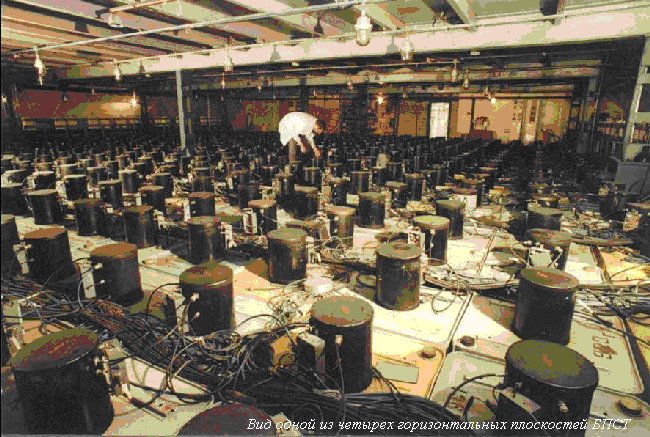
BNO INR RAS - Laboratory Baksan underground scintillation telescope. Academician G.T. Zatsepin and Doctor of Physical and Mathematical Sciences S.P. Mikheev. Most of the work is carried out jointly with the Department of High Energy Leptons and Neutrino Astrophysics at INR. BAKSAN UNDERGROUND SCINTILLATION TELESCOPE (BPST) In 1978, the 3200-channel underground scintillation telescope (UST), one of the largest underground installations of that time, was launched. In the 80s - 90s, its modernization began - an additional recording layer was installed, a second line for recording events was being manufactured, construction of the ANDYRCHI installation above the telescope and a muon detector under the COVER installation were underway. BPST is a multi-purpose underground installation designed to solve a wide range of problems in astrophysics, particle physics and cosmic rays (cosmic rays). The telescope is located in a mine opening with a volume of 12,000 cubic meters. meters at a distance of 550m from the beginning of the horizontal tunnel.

The effective thickness of the soil above the telescope is 850 g/cm2. The installation is a four-story building with a base area of (16.7 * 16.7) m2 and a height of 11.1 m. The telescope building is assembled from concrete blocks 0.8 m thick, made of low-radioactive concrete based on ultramafic rocks (dunites). Interfloor ceilings 0.8 m thick are covered with fine fractions of dunite crushed stone (150 g/cm2). Six outer and two inner recording layers (four horizontal and four vertical layers) are made from standard liquid scintillation detectors. The total number of detectors is 3,180, and the total weight of the scintillator in them is ~ 330 tons The standard module is an aluminum container with dimensions (0.7 * 0.7 * 0.3) m3, filled with a liquid scintillator based on white spirit with the additions of PPO (1 g/l) and POPOP (0.03 g/l).

The inner surface is covered with white enamel, which diffusely reflects light. The detector volume is viewed by one photomultiplier tube FEU-49 with a photocathode diameter of 0.15 m. The passage of a charged relativistic particle is accompanied by an energy release of ~50 MeV, which corresponds to the appearance of a signal with an amplitude of 70 mV at the anode of the photomultiplier at a load of 75 Ohms. The anode signals of the detectors of each layer are summed sequentially into groups of 25, 100 and 400 detectors. In addition to the signal from the anode, information is taken from the 5th and 12th dynodes and is supplied, respectively, to the amplitude (A) - time (T) converters and the integral discriminator located on the PMT casing. The threshold of the "A - T" converter corresponds to the passage of ten relativistic particles through the detector, and the dynamic range of the time-amplitude converter is ~2 * 103. The threshold of the integral discriminator corresponds to an energy release of 10 MeV.

Signals from individual "A - T" converters, integral discriminators and anode signals from groups of detectors of each layer of the telescope are supplied to recording devices located in the equipment room for: determining the coordinates of the detectors through which the particles passed; measurements of the relative time of flight of a particle through the telescope layer (accuracy 2 ns); measurements of energy releases in individual detectors in the range of 0.05 - 1000 GeV; measurements of energy releases in a separate plane from 10 MeV to several tens of TeV; recording the shape of the anode signals of each layer for rare events.

Back to the list

  • Research directions
  • Installations
  • Applied Research
  • Dissertation Council
  • Council of Young Scientists
  • Conferences
  • Awards
+7-495-850-42-01
+7-495-850-42-01
Request a call
Email
inr@inr.ru
The address
Moscow, V-312, Prospekt 60-letiya Oktyabrya, 7a
Working hours
Mon. – Fri.: с 9:00 до 18:00
Moscow, V-312, Prospekt 60-letiya Oktyabrya, 7a

© 2026 INR RAS
Privacy policy
Главная Кабинет Контакты Сотрудники Документы