(Neutron complex INR RAS) - a unique scientific installation at INR RAS
At the Institute of Nuclear Research of the Russian Academy of Sciences, on the basis of a high-current linear proton accelerator, a complex of experimental installations for neutron research was built, including an IN-06 pulsed thermal neutron source, a RADEKS installation for radiation materials science (a source of thermal and epithermal neutrons) and a high-intensity neutron spectrometer for slowdown time in lead SVZ .
The physical launch of IN-06 and the RADEKS installation was carried out at the end of 1998 with a beam energy of 209 MeV, an average current of no more than 0.1 μA, a proton pulse duration of 60 μs and a frequency of 1 Hz.
In 2000, a 100-ton high-intensity deceleration time spectrometer in lead SVZ was launched.
In 2002, a beam with a current of 50 mA was transferred to the RADEKS installation. A time-of-flight neutron spectrometer (TOFNS) was created on the basis of the RADEX neutron source.
Pulsed neutron source

According to the design, IN-06 consists of two independent neutron sources, each located in its own box in a common biological shield, and capable of operating simultaneously. The difference is determined by the duration of the proton pulse directed at the neutron-producing target. In the first box there is a tungsten target with a water moderator, which is currently supplied with a proton beam with parameters determined by the accelerator. The source is intended to provide fundamental research in the field of condensed matter physics, nuclear physics, biology, chemistry, etc.
The development of a neutron source in order to increase the neutron flux per one proton of the primary beam involves the creation of a target with a beryllium reflector. It is possible to place a multiplying target with limited multiplication in the second box.
Pulsed neutron source
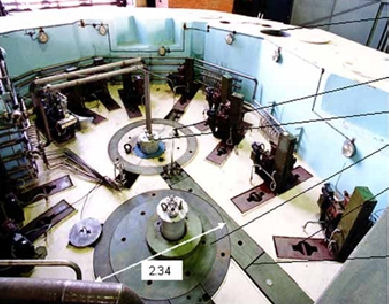
To extract neutron beams from the moderator to experimental devices, the source has seven channels with a diameter of 204 mm. In this case, four channels are directed into the experimental hall, and three - outside the experimental building. The small number of channels imposes specific requirements on installations and conditions for neutron extraction: multifunctionality of installations and, if possible, splitting of neutron beams to increase the number of installations used.
Simultaneously with the work on putting into scientific operation and optimizing the parameters of IN-06, the creation of installations at the INR RAS began, together with teams from different institutes. There are additional possibilities for using such installations on the RADEKS IPNS channels, including in a different neutron energy range (in a harder spectrum, not available with reactor-type sources). The sources of thermal neutrons IN-06 and epithermal neutrons RADEKS of the neutron complex of the INR RAS complement each other, providing the opportunity to use a wider range of neutrons
Neutron diffraction installations of the first stage on the pulsed thermal neutron source IN-06 INR RAS.
1. "Horizon" - a reflectometer with a horizontal neutron scattering plane for studying surfaces and nanostructures (nanotechnology materials). The installation was created jointly with PNPI RAS. An analogue is available abroad in England on the ISIS pulse source.
2. "Hercules" - diffractometer-spectrometer for studying the structure and phase transitions of substances under extreme conditions - high pressure up to 100 kbar and low temperatures up to 12 K, including studies of hydrogenation of samples (hydrogen energy materials) during an in situ experiment. The installation is equipped jointly with the Russian Research Center "KI" and the Institute of Higher Physics of the Russian Academy of Sciences.
3. "MNS" is a multi-purpose installation for structure determination, which includes detection units using the time-of-flight focusing method, a high-intensity diffraction unit and a small-angle scattering unit. The installation is being implemented jointly with the Lebedev Physical Institute.
4. "Crystal" - a diffractometer for studying the structure of single crystals at various temperatures and pressures.
For the successful implementation of the first stage of the INR RAS Neutron Center for the study of condensed matter, special attention is paid to the issues of registration, collection and analysis of information coming from the facilities. In particular, a modern two-coordinate position-sensitive neutron detector is being created at the Institute for Nuclear Research RAS, which is necessary for more efficiently obtaining information about the structure of the object under study.
The second stage of the neutron center involves carrying out, jointly with PNPI, RRC "KI", (Gatchina), work on equipping channels with mirror neutron guides with their bifurcation to increase the number of installations. This stage of work also includes the completion of the creation of a multifunctional neutron spectrometer.
Scientific research program
The macroscopic properties of a substance that determine its practical application, such as thermal and electrical conductivity, strength, elasticity, etc., depend on the atomic, supraatomic, supramolecular structures, and are also, in some cases, determined by the thermal mobility of nuclei, molecules and their formations . The most important role is played by structural elements with characteristic sizes from a few to a thousand angstroms.
The study of structure and dynamic features consists of analyzing data on the scattering of radiation in matter. The ability of neutrons to penetrate deeply into matter makes it possible to study materials under various conditions: temperatures, pressures, etc.
The most important property of a neutron is the presence of a magnetic moment, which provides ample opportunities in the study of magnetic phenomena. In recent years, neutrons have been increasingly used to study systems with strong magnetic correlations, namely: low-dimensional magnets, superconductors, fullerenes, heavy fermions, etc.
Particular attention is paid to the study of nanocrystals. It is of interest to carry out measurements in real time, which will provide information about processes such as oxidation, various relaxations, etc.
Disordered materials, which include disordered crystals, glasses, and liquids, often have better mechanical and magnetic characteristics than crystalline ones and are therefore of interest for studying them using neutrons.
One of the most developing areas of neutron use is the study of high-molecular compounds, which include polymers, block copolymers, liquid crystals, micellar solutions, lyotropic mesophases of amphiphilic molecules, colloidal suspensions, emulsions, gels, and surfactants. The most striking property of such systems is their wide polymorphism.
The use of neutrons in structural chemistry will make it possible to advance along the path of creating materials with specified properties (ceramics, magnetic materials, etc.) and to study interaction processes in the metal-hydrogen system. Real-time measurements will make it possible to study chemical kinetics, solid-state reactions, phase transitions, and relaxation processes.
Biology and biotechnology are the most promising areas of application of neutrons. The ability of neutrons to actively sense hydrogen, both statically and dynamically, makes it possible to successfully determine the details of the structure and functioning of biological systems. However, solving these problems requires high neutron fluxes, a longer wavelength part of the neutron spectrum (this requires mirror neutron guides) and efficient neutron detectors.
Materials science is a separate area of research using neutrons, which is associated with the study of the properties of materials by changing the microstructure. Such microstructures include point defects, dislocations, interphase boundaries, microcracks, pores, etc. In recent years, work has been intensively developing on the study of internal stresses and texture by neutron diffraction, as well as the problems of plasticity and fatigue of materials associated with these problems. Thus, neutron scattering provides unique opportunities for studying real industrial components and structural units.
A new area is the application of neutrons in geosciences. Experimental research consists of studying the texture of rocks and minerals, as well as the influence of external pressure on the structure of samples. Structural studies provide information about planetary geology, earthquake prediction, and volcanic eruptions.
Multipurpose target complex in the second box of the neutron source.
In the second box it is possible to create a multi-purpose installation for the following work:
-
studying various aspects of transmutation, the electronuclear method of energy production;
-
carrying out experimental work related to the production of tritium based on a high-current proton beam;
-
development of neutron-rich and neutron-deficient isotopes for medicine;
-
development of neutron therapy;
-
creating an additional experimental base on external beams for research in the field of condensed matter physics, nuclear physics and biology.
On the basis of the high-current proton accelerator operating at INR and the created infrastructure of the neutron source, it is possible to create a reconfigurable stand with an average power of up to 6 MW for the research organizations of Rosatom and the Academy of Sciences to conduct a cycle of research in the field of the electronuclear method of energy production and transmutation of radioactive elements for the purpose of comprehensive testing of various concepts and development of technological experience. Such a stand, created from special replaceable modules and having no analogues in the world, would simultaneously have the features of the Large Physics Stand and the BR-10 reactor. The presence of such a demonstration stand within the structure of Rosatom and the Academy of Sciences would make it possible to systematize scattered scientific research in this area, retain scientific personnel and load them with work that can actually be implemented in practice, providing the basis for one of the possible directions of the energy sector of the future. Vertical channels designed for irradiating samples could be used for the development of new technologies for the production of tritium and the production of isotopes for medical purposes. The creation of such a stand would stimulate bringing the parameters of the linear accelerator to the design parameters. The incidental use of this stand as a source of neutrons with a long pulse duration will make it possible to add at least five more to the seven neutron beams of the pulsed neutron source located in the first box. This would significantly expand the capabilities of the neutron complex and provide research institutes in the Moscow region with additional neutron beams and an experimental base for research in the field of condensed matter physics and nuclear physics.
Spectrometer for neutron moderation time in lead INR RAS
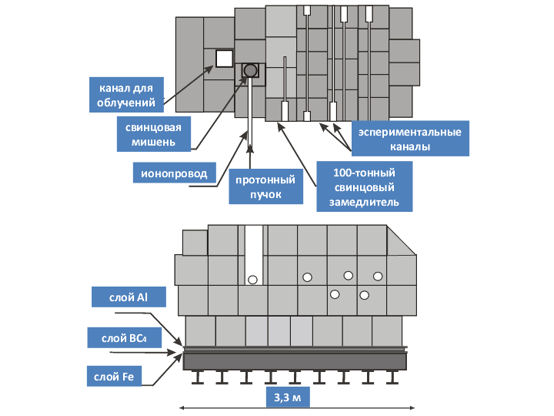
The created 100-ton neutron spectrometer for slowdown time in lead (SVZ-100) belongs to the third generation SVZ, in which neutrons are generated due to nuclear processes (spallation neutrons) caused by an intense proton beam. This SVZ can be used for research in the field of fundamental and applied physics.
Sketch of the experimental setup SVZ-100
When operating at a power of 30 kW, it is proposed to use a liquid metal lead-bismuth target. Russia has priority and unique experience both in the creation of SVZ (in RAS institutes) and in work with liquid metal targets (in Rosatom organizations). Combining these two possibilities in one installation would take research to a fundamentally new level.
The third generation SVZs have a record aperture ratio for neutron spectrometers with an operating energy range of 1 eV - 30 keV.
While noticeably inferior in resolution to the time-of-flight method, SVZ provides a gain of 103 - 104 times in aperture ratio.
SVZ-100 provides the opportunity to study cross sections of rare reactions and reactions with microsamples (radioactive and rare nuclei), which are of broader scientific interest in those experiments where energy resolution is not decisive.
Experimental setup
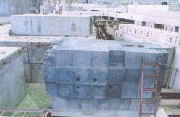
SZV-100 in the process of assembly
In 2000, the physical launch of a 100-ton spectrometer for the time of neutron moderation in lead SVZ-100 was carried out. With a proton beam pulse duration of 1.5-2 μs and a repetition rate of 50 Hz, record parameters for this class of installations were obtained: resolution of about 27%, which is close to the theoretical value (26%), and intensity of ~1014 n/s. A reliable energy range corresponds to 1 eV÷ 2 keV. Reducing the pulse duration to (0.25 ÷ 0.5) μs allows you to expand the measurement range to 30 ÷ 50 keV. With a relatively low resolution, SVZ-100 has a unique sensitivity, which makes it possible to obtain neutron data on microsamples of different isotopic compositions.
Together with the State Research Center "Institute of Physics and Energy", a program for measuring the neutron cross sections of a number of minor actinides was implemented. These data are included in the international nuclear database.
Pulsed source of thermal and epithermal neutrons based on a modified proton trap - installation for radiation materials science (RADEX)
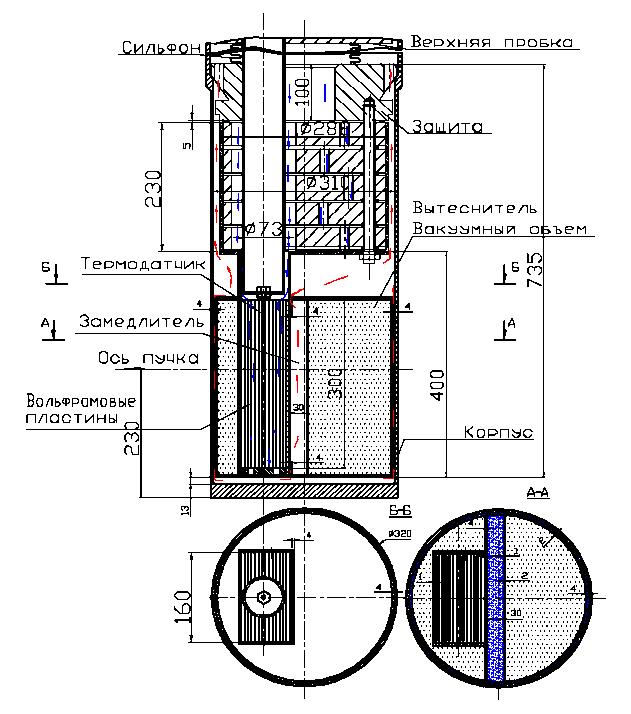
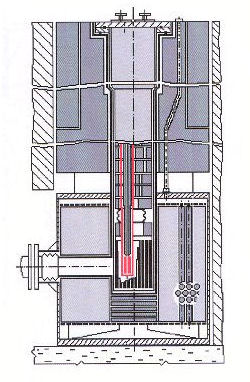
The RADEKS installation was created for irradiating samples of structural materials in mixed proton and neutron fields with their subsequent delivery to hot laboratories for post-radiation studies. There is a fundamental possibility of irradiating samples in purely neutron fields. The active zone of the installation is assembled from titanium-coated tungsten plates, cooled by water. Inside the active zone, at a depth of ~4 m from the top cover and at a distance of ~40 mm from the first wall, there is a cylindrical irradiation channel with a diameter of 52 mm. and height 100 mm. Radiation tests of standard samples of promising alloys can be carried out in this channel.
Currently, the RADEKS facility is used as a neutron source for time-of-flight experiments. For this purpose, the trap part was modified. As a result, the time-of-flight spectrometer VPNS RADEKS was created.
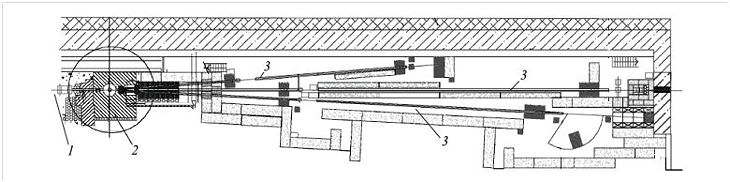
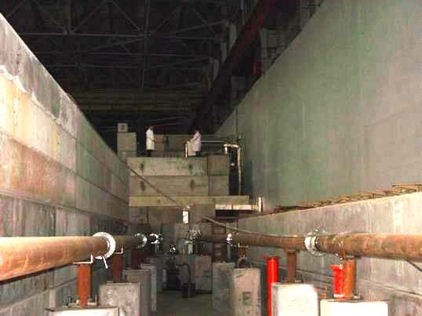
The tungsten target of the RADEKS installation is optimized to absorb a proton beam with an energy of ~ 250 - 350 MeV and an average current of up to 150 μA. Horizontal and vertical vacuum neutron guides make it possible to conduct time-of-flight studies at flight distances of up to 50 m. When adjusting the duration of the accelerator beam current pulse in the range from 0.25 μs to several tens of microseconds, neutron fluxes are estimated at the level of 4 * 1012 ÷ 9 * 1014 n/ s, and energy resolution (0.15 ÷ 2)%.
A proton beam with a power of about 8 kW (average current 35-40 μA, energy 209 MeV) was transmitted to the RADEKS time-of-flight spectrometer for the first time on November 10, 2006.
RADEKS installation diagram
Neutron time-of-flight spectrometer INR RAS
In Fig. 1 and 2 show the design of an active W-target and vacuum channels. Currently there are 6 experimental zones to accommodate recording equipment.
|