
Study of neutron-nuclear interactions using a time-of-flight neutron spectrometer
Neutron time-of-flight spectrometer INR RASAmong intense pulsed neutron sources, the most promising at present are high-current proton accelerators with an energy of 0.3-1.5 GeV, because they give: 1. The highest neutron fluxes with the lowest energy release per neutron produced (3-5 times less than fission and 30-50 times less than photonuclear reactions) 2. Wide range of neutrons 3. Widely adjustable range of neutron pulse durations 4. Relatively low background gamma radiation from the target. The linear proton accelerator is the basic installation of the neutron complex of the MMF INR RAS. Currently it has the following options: Proton energy up to 423 MeV. Pulsed proton current up to 16 mA. Proton pulse frequency 1 - 50 Hz. The duration of proton pulses is 0.25-200 μs.
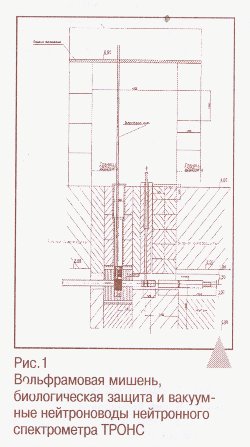
In the experimental hall there is a through trap of the proton beam RADEKS (RADIATION EXPERIMENTS), which is today modified into a neutron source for time-of-flight studies. The neutron time-of-flight spectrometer consists of the following main parts: 1. Tungsten target optimized to absorb a proton beam with energy up to 423 MeV at an average current of up to 150 μA 2. Water moderator for the formation of a neutron spectrum in the region of thermal and resonant neutrons 3. Vacuum time-of-flight channels 4. Neutron beam traps 5. Biological protection of the neutron source and experimental areas 6. Detection equipment, control and experiment control systems 7. Center for collecting, accumulating and processing experimental information.
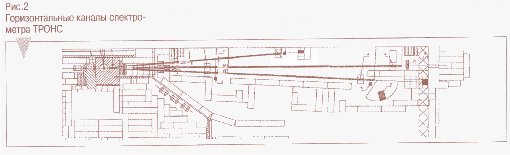
In Fig. 1 and 2 show the design of an active W-target and vacuum channels. Currently there are 6 experimental zones to accommodate recording equipment. The photograph shows a general view of the time-of-flight spectrometer from the side of the 50-meter flight base (zone No. 3). For time-of-flight studies, the structure of the neutron beam must meet the experimental requirements. Neutron pulses must be short in duration to achieve high energy resolution and relatively low in frequency to avoid the overlap of recycle neutrons. Therefore, the operating modes of the neutron spectrometer should differ in the region of slow and resonant neutrons. In the first case, the pulse duration can be equal to 10-100 μs, and in the second ~ 1-2 orders of magnitude less. The standard pulse duration of the spectrometer is 60 μs and shorter durations are obtained using a proton beam chopper up to 0.25 μs with loss of intensity. In standard mode, the maximum integral neutron flux from the target reaches 1.2*1015 n/s*4π. The calculation shows that on the surface of the moderator the neutron flux density is 2*1011 n/s*cm2 in the energy range from thermal to 423 MeV. These calculated data were confirmed experimentally by measuring the neutron flux density on the surface of a W target using the method of activation analysis of irradiated standard samples, which were placed in the vertical channel of a neutron source. The measured neutron flux density is (2.5 ± 1.7}*109 n/cm2*s, which corresponds to the integral intensity of evaporation neutrons in the target (7.5 ± 5.5)*1012 n/s for an average proton current of 0.6 μA. The magnitude of the error is determined by the accuracy of the radioactive data decay of irradiated samples.
The currently obtained parameters of the time-of-flight spectrometer make it possible to conduct research on the program of studying the characteristics of neutron resonances of deformed nuclei (lanthanides and transuraniums) and average neutron cross sections for the needs of astrophysics and transmutation. 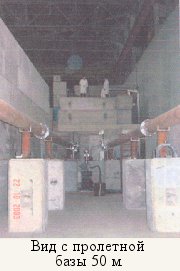 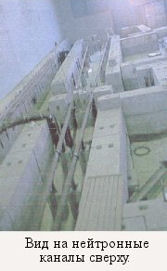
|
|
CONTACT PERSONS:
Dzhilkibaev Rashid Maksudovich 8(495)850-42-50 rmd@inr.ru Khlyustin Denis Vladimirovich 8(495)850-42-52, 8(495)850-42-17 hlustin@inr.ru, den.khliustin@gmail.com |
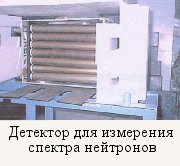
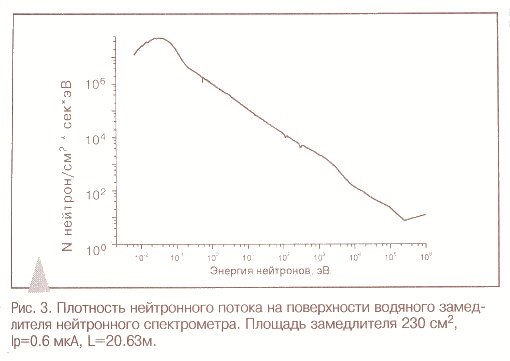
 Energy dependence of flux density neutrons per. The moderator surface was measured using SNM-18 neutron counters and two gamma detectors based on NaJ(Tl) with an amorphous B-10 target located outside the neutron beam, also at an average proton current of 0.6 μA. The results are presented in Fig.3. In the region of slow neutrons, the spectrometer is not inferior in its parameters to modern pulsed neutron spectrometers, and in the resonant energy region, where high energy resolution is needed, it has an average energy resolution.
 By increasing the energy and current of the proton beam to the design values, the parameters of the neutron spectrometer will significantly improve, and the commissioning of the storage ring will place it among the best pulsed neutron sources in the world.