
Nuclear photonics. Experiments at the femtosecond laser facility at the ILC MSU
Currently, work at LFNR in the new scientific direction "Nuclear Photonics" is being carried out in joint experiments on the basis of a femtosecond laser complex with terawatt power at the ILC of Moscow State University. M.V. Lomonosov. The key words that define the essence of this direction are new generation gamma sources, which, thanks to their unique parameters, allow solving a number of important fundamental and applied problems.
For the first time, gamma beams with a fairly high energy (several hundred MeV), monochromaticity at the level of 1%, intensity up to 10 MHz, degree of polarization close to 100%, were obtained and used in joint photonuclear experiments (INR RAS and BINP SB RAS) at electron storage devices VEPP-3 and VEPP-4 in Novosibirsk about 30 years ago. In this case, the method of Compton inverse scattering of laser photons on storage electrons was used. Then this method became widespread in Europe (GRAAL project on the ESRF electron storage ring), the USA (LEGS installation), Japan (LEPS collaboration), etc.
In recent years, new generation gamma sources began to be created on the basis of high-power pulsed lasers, which is why the term “Nuclear photonics” actually appeared. The first scientific conference where this term was voiced took place in Japan in 2014 (Nuclear Physics and Gamma-ray sources for Nuclear Security and Nonproliferation" (NPNSNP) "Tokai-mura, Japan). As the title of this conference suggests, the main focus was on the problems of ensuring nuclear safety using gamma introscopy. Now conferences called “Nuclear Phtonics” have become regular and are held every two years (Nuclear Photonics, Monterey, USA, 2016, Bresow, Romania, 2018).
The main tasks that are solved on pulsed laser systems partially overlap with those implemented on electronic storage devices, but still have their own specifics associated with high pulsed beam power and, accordingly, a very low beam duty cycle. At the femtosecond laser facility at the Moscow State University ILC, experiments are being conducted to create pulsed sources of relativistic electrons, positrons, gamma rays and neutrons for their subsequent use in various fundamental and applied research.
At INR RAS together with Moscow State University. At M.V. Lomonosov, experiments are being conducted to study the generation of X-ray and gamma radiation, as well as the acceleration of electrons under the influence of femtosecond terawatt laser pulses. Installation parameters: wavelength 800 nm, pulse duration 50 fs, pulse repetition frequency 10 Hz, pulse energy 50 mJ, focal diameter 4 mm. The laser radiation intensity on the target is 1019 W/cm2, the electron beam quasi-temperature is ~1 MeV.
It is shown that the main process of generating such beams is the capture and acceleration of electrons by a laser field. The parameters of the beams in each laser shot were measured using a magnetic spectrometer and a LANEX scintillation detector, as well as a Medipix detector. The resulting beams of relativistic electrons were used to study the photodisintegration of beryllium and deuterium with registration of the resulting neutrons in the near threshold energy region.
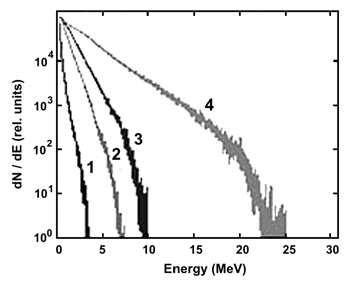
Img. Electron spectra measured on a laser-plasma source at a laser power of 1018 W/cm2, 5 x 10¹⁸ W/cm2, and 1019 W/cm2 (curves 1-3, respectively). Curve 4 corresponds to the simulation results using the 2D3V PIC program at a laser power of 5 x 10¹⁹ W/cm2.