
Search for rare nuclear decays and electroweak processes at underground low-background facilities of the BNO
BNO INR RAS - Laboratory of Low Background Research.The laboratory's low-background cameras are located at depths of 660, 1000 and 5000 meters of water equivalent. Thanks to the use of ultrabasic rock - dunite and low-background concrete as protective materials, the radiation background of the uranium and thorium series in the laboratory is reduced by more than 200 times relative to the background level of the surrounding rock.
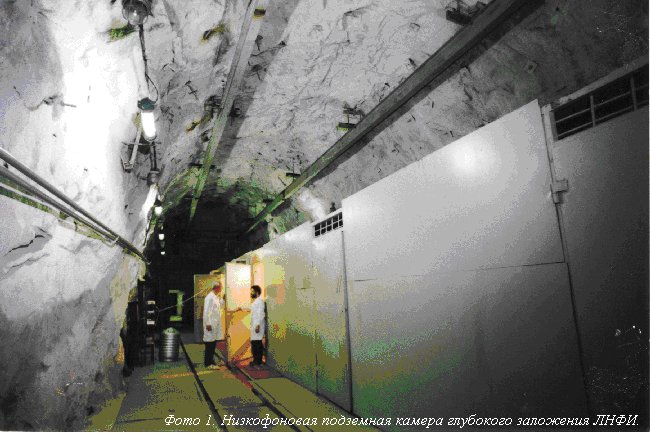
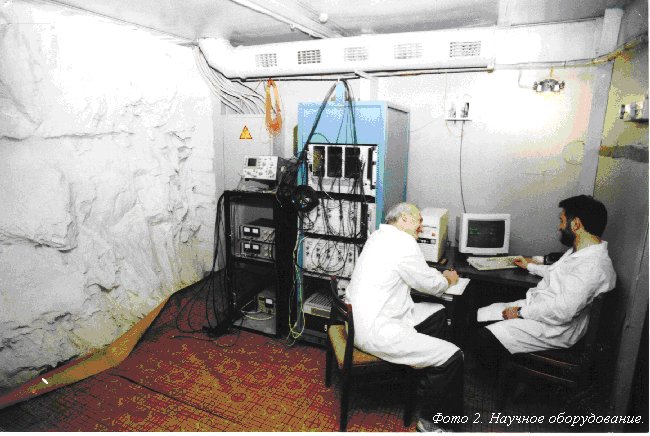
The scintillation, semiconductor, and ultra-low background gas detectors housed in these laboratories are surrounded by additional layers of passive shielding made from lead, copper, tungsten, and borated polyethylene. Active scintillation protection against penetrating components of cosmic rays is also used. The low-background research carried out includes research of both fundamental and applied nature. A number of experiments aimed at searching for very rare nuclear decays and electro-weak processes are carried out at underground low-background installations of the BNO:
As a result of experimental testing of electron stability in 1977, the limit was obtained
T ≥ 2 * 1023 лет
for the decay of an electron with the emission of three or more neutrinos, which is a record to date.
The search and study program for double beta decay (one of the few processes that carries information about both the type and mass of neutrinos) includes measurements of a large set of enriched isotopes 76Ge, 100Mo, 150Nd, 96Zr, 58Ni, 130Te and 136Xe using various detection methods:
The greatest progress was recently achieved in an experiment to search for neutrinoless double beta decay of 76Ge, carried out within the framework of the international collaboration IGEX (Russia - USA - Spain). In this experiment on the HPGe-76 de-tector weighing 1 kg, a record low background level of 0.04 counts/keV * year * kg was achieved in the region of the expected peak from neutrinoless decay (2038 keV), which made it possible to obtain a limit on the mass of the Majorana neutrino of the order 1 eV on only one detector over a period of about six months.
In total, about 15 kg of enriched 76Ge isotope will be used in this international experiment and the total measurement time will be at least 5 years, i.e. Already at the present stage, the actually planned sensitivity of the experiment to determine the neutrino mass is estimated as 0.1 eV. Three types of detectors are planned to be used in experiments to search for candidate particles for the role of the hidden mass of the Universe. These studies are and will be conducted mostly in collaboration with scientists from the USA. These detectors include:
A record low energy detection threshold of 1.5 keV was achieved at the BNO Laboratory for one of the 1 kg HPGe detectors, which, in combination with an ultra-low background, makes it possible to significantly expand the boundaries of the forbidden regions for the masses and interaction cross sections of particles - candidates for the role of Hidden Mass.
In the beta spectrum of the 14C nucleus, a search for an admixture of “heavy” neutrinos with a mass of 17 keV was carried out using a high-pressure wallless proportional counter. Based on a comparison of the shape of the measured β - spectrum of 14C with the calculated shape of the β - spectrum for allowed transitions, one of the best limits for the 17 keV impurity was established. neutrino:
sin2 Θ ≤ 0,0022 (90% у.д.)
|
|
BNO INR RAS - Deep underground laboratory |
|
|
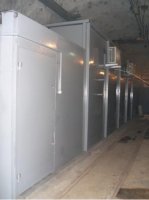
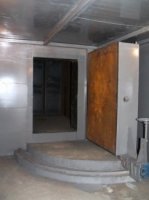
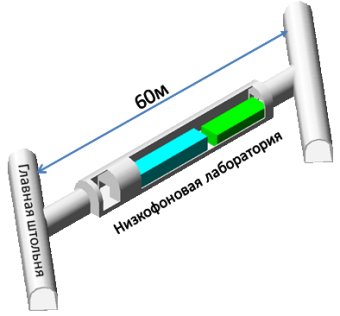
At the end of December 2008, a new underground laboratory was put into operation at the Baksan Neutrino Observatory of the Institute of Nuclear Research of the Russian Academy of Sciences, located at a record depth of about 5000 meters of water equivalent inside Mount Andyrchi (3700 meters deep) in the North Caucasus.
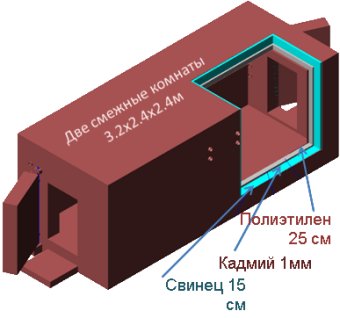
The thickness of the rock, which weakens the background of penetrating cosmic ray radiation billions of times, and the materials used in the construction with a low level of natural radioactivity: a special type of concrete based on dunite, about 200 tons of pure lead, cadmium, borated paraffin, oxygen-free copper, etc., allow to provide unique conditions of ultra-low radiation background for fundamental and applied research in the field of nuclear physics, radiation biology and metrology. |
Contact person:
Kuzminov Valery Vasilievich, Doctor of Physical and Mathematical Sciences, bno_vvk@mail.ru tel.8(866)387-51-49, 8(866)387-51-32, 8(928)708-20-84 |
|