
Searching for neutrino bursts from collapsing stars using the Baksan Underground Scintillation Telescope and the COLLAPSE detector
BAKSAN UNDERGROUND SCINTILLATION TELESCOPE (BPST)
In 1978, the 3200-channel underground scintillation telescope (UST), one of the largest underground installations of that time, was launched. In the 80s - 90s, its modernization began - an additional recording layer was installed, a second line for recording events was being manufactured, construction of the ANDYRCHI installation above the telescope and a muon detector under the COVER installation were underway.
BPST is a multi-purpose underground installation designed to solve a wide range of problems in astrophysics, particle physics and cosmic rays (cosmic rays).
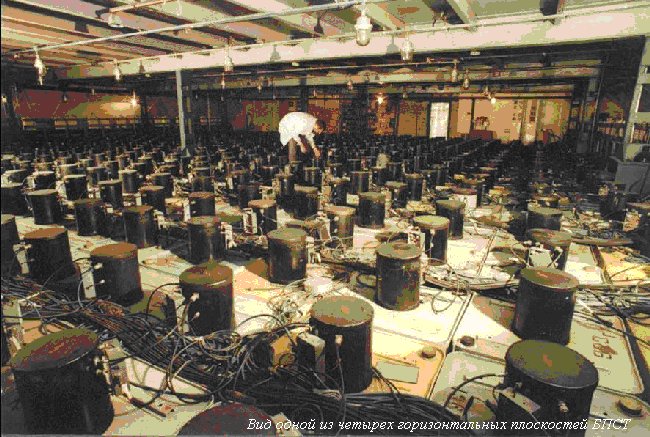
The standard module is an aluminum container with dimensions
(0.7 * 0.7 * 0.3) m3,filled with liquid scintillator based on white spirit with additives PPO (1g/l) and POPOP (0.03g/l). The inner surface is covered with white enamel, which diffusely reflects light. The detector volume is viewed by one photomultiplier tube FEU-49 with a photocathode diameter of 0.15 m.
The passage of a charged relativistic particle is accompanied by an energy release of ~50 MeV, which corresponds to the appearance of a signal with an amplitude of 70 mV at the anode of the photomultiplier at a load of 75 Ohms. The anode signals of the detectors of each layer are summed sequentially into groups of 25, 100 and 400 detectors.
In addition to the signal from the anode, information is taken from the 5th and 12th dynodes and is supplied, respectively, to the amplitude (A) - time (T) converters and the integral discriminator located on the PMT casing.
The threshold of the "A - T" converter corresponds to the passage of ten relativistic particles through the detector, and the dynamic range of the time-amplitude converter is ~2 * 103.
The threshold of the integral discriminator corresponds to an energy release of 10 MeV.
Signals from individual "A - T" converters, integral discriminators and anode signals from groups of detectors of each layer of the telescope are supplied to recording devices located in the equipment room for:
- determining the coordinates of the detectors through which the particles passed;
- measurements of the relative time of flight of a particle through the telescope layer (accuracy 2 ns);
- measurements of energy releases in individual detectors in the range of 0.05 - 1000 GeV;
- measurements of energy releases in a separate plane from 10 MeV to several tens of TeV;
- recording the shape of the anode signals of each layer for rare events.
Registration system
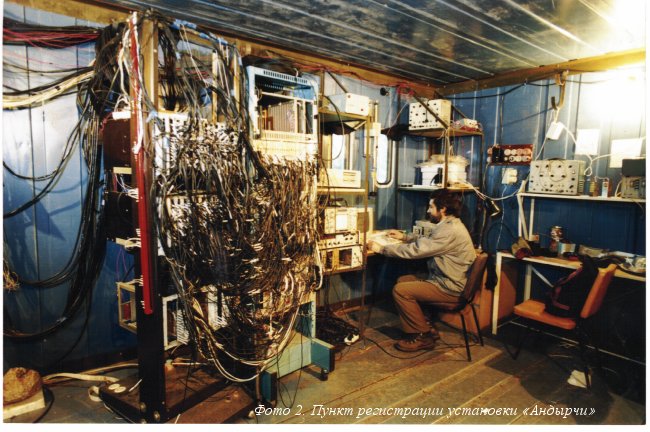
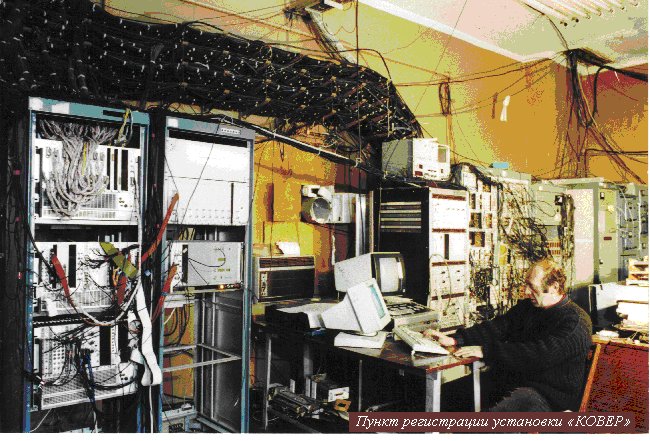
Information from recording devices, as well as from absolute and relative time systems, is received via a direct access channel to the computer. Every 900 seconds, all accumulated and pre-processed information is transmitted via fiber optic cable to the server. About a dozen diagnostic programs are simultaneously running on the telescope, which allow you to have information about the performance of all telescope systems.
MAIN RESULTS OF THE BAKSAN TELESCOPE EXPERIMENTS
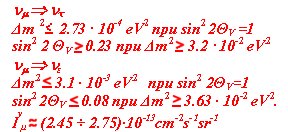
- The flux of muons produced by cosmic ray neutrinos was measured, and restrictions on the parameters of neutrino oscillations were obtained;

- Restrictions on the flux of high-energy neutrinos from local sources were obtained. Muon flux from neutrinos, from the Galaxy plane: Fν<4 * 10-14 cm-2 s-1sr-1.
- The world's best constraint on the flux of slow (2 * 10-4≤ν/c<10-1) heavy magnetic monopoles was obtained: P ≤ 5.5 * 10-16 cm-2 s-1 sr-1.
- The amplitude (12.3 ± 2) * 10-4 and phase (1.6 ± 0.8) of the first harmonic of anisotropy in sidereal time were measured.
- For 25 years, a service has been monitoring neutrino bursts from the gravitational collapse of stars in the Galaxy. Based on observation data for the entire period (living time 22 years), the following restrictions on the frequency of outbursts ƒ and the average interval between outbursts of supernovae T (at 90% of the scale) were obtained: ƒ < 0.177 year-1, T > 5.65 years;
- Simultaneously with installations in the USA, Italy, and Japan, a neutrino flux from the collapse of a star in the Large Magellanic Cloud SN 1987A was detected.
- The stability of the proton in the nuclei of matter was studied; The resulting limit on the proton lifetime: T > 0.9 * 1031 years, was the best in the world at that time.
- The flux of high-energy neutrons generated by muons in rocky soil was measured: Pn≤ (3.8 ± 0.5) * 10-8 m-2 s-1.
- A method for separating hadronic and electromagnetic cascades, based on recording π-μ-e decays accompanying the cascade, has been developed and experimentally implemented.
- The total hadronic photoabsorption cross section was measured up to photon energies of 10 TeV; The results obtained are consistent with the predictions of the off-diagonal generalized vector dominance model.
- Data on measuring the chemical composition of primary cosmic rays with energies of 1012 - 1016 eV are in good agreement with the results of direct measurements at lower (1012 eV) energies.
- Based on the measured fraction of nuclear cascades, experimental data on the γ-N interaction cross section in the energy range √S=40 - 130 GeV were obtained. These data, combined with data obtained in DESY at the HERA collider, confirm the effect of faster growth of the photon-hadron cross section compared to the growth of hadron-hadron interaction cross sections.
- Two new methods for studying the muon component of extensive air showers have been proposed, developed and implemented; methods make it possible to obtain new information about the energy spectrum and mass composition of PCR in the energy range 1015 - 1017 eV.
- A technique has been developed and implemented for converting from the muon multiplicity spectrum to the EAS spectrum based on the total number of muons, which, unlike the multiplicity spectrum, is an objective (installation-independent) characteristic of the PCR flux. This technique allows for direct comparison of data obtained in different experiments with muon groups.
"ANDYRCHI" INSTALLATION
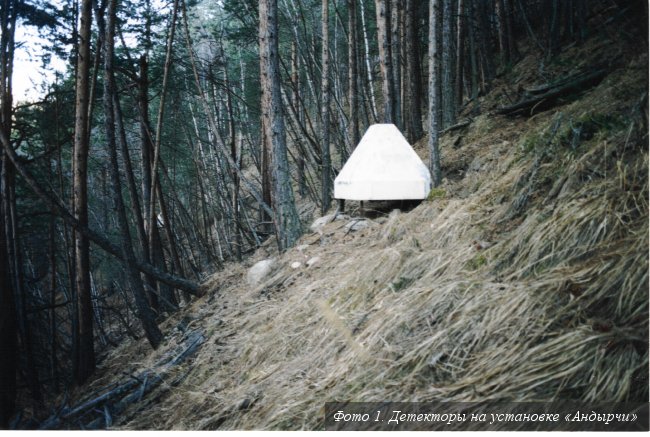
In 1995, the ANDYRCHI installation began its operation, designed to record air showers with energy greater than 1014 eV.
The installation is located on the slope of Mount Andyrchi, above the telescope, and consists of 37 standard detectors based on plastic scintillators with an area of 1 m2. The detectors are located on an area of ~ 4.5 * 104 m2 with a step of ~ 40 m. The central detector of the installation is located above the BPST, the vertical distance is ≈ 350 m.
The facility conducts research in the field of ultra-high energy γ-astronomy and anisotropy of primary cosmic rays in the energy range 1014-1017 eV
The BPST-Andyrchi complex is unique and currently has no analogues in the world. One of the experiments currently being carried out at this complex is testing the hypothesis about a change in the elementary act of the nature of the interaction of primary particles with the nuclei of air atoms (and thus, the break in the EAS spectrum for Ne is associated with this phenomenon).
The Andyrchi installation is a ground-based installation that operates autonomously. For such installations, safe operation during periods of thunderstorm activity is very important. This problem has been successfully solved; the development is original, unique for ungrounded installations. The operating principle of lightning protection is based on the registration of pulsed electromagnetic oscillations resulting from lightning discharges.
INSTALLATION "CARPET"
The COVER installation, which began operation in 1973, is designed to study the hard component of cosmic rays and extensive atmospheric showers, and has a continuous recording area of 200 m2. The central part of the installation and six remote points with an area of 9 square meters. m. are composed of the same standard liquid scintillation detectors as the underground scintillation telescope.
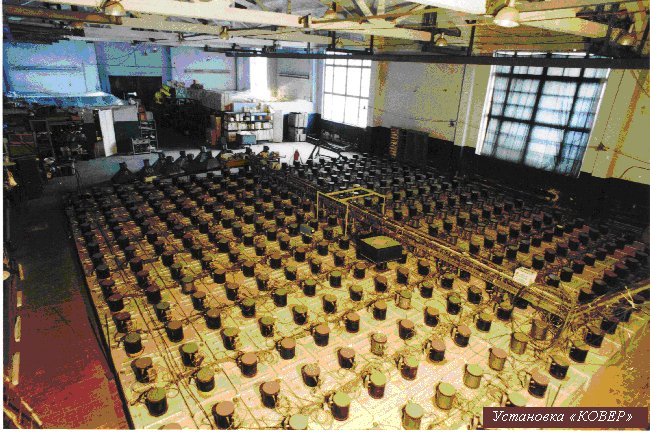
Main areas of research
- study of the structure of the central part of extensive air showers.
- Analysis of the events made it possible to interpret subbarrels in multi-barrel showers as a consequence of the generation of jets of particles with large transverse momenta and to estimate the cross section of this process in hadron-hadron interactions at an energy in the center of mass system √S ~ 500 GeV. The result of this experiment, which confirmed the predictions of quantum chromodynamics for the first time, was published earlier than the corresponding cross section measured at the SPS collider at CERN.
- study of cosmic ray variations
- The enormous counting rate of single cosmic ray muons allows for high statistical accuracy over short time intervals (0.03% per 4 minutes). A new type of sporadic variations with a short characteristic time associated with meteorological effects has been discovered - a strong correlation with the magnitude of the electric field in the atmosphere (observed only during a thunderstorm).
- Perhaps the most interesting of the sporadic changes in cosmic ray intensity is the gigantic increase during the powerful solar flare of September 29, 1989. For the first time in this event, the presence of particles of solar origin with an energy of at least up to 1010 eV was observed, and the most striking data were obtained precisely at the COVER installation.
- study of cosmic ray anisotropy
- The obtained cosmic ray anisotropy value at 1013 eV is (0.057 ± 0.005)%.
- ultra-high energy gamma-ray astronomy
- Atmospheric showers with energies greater than 1014 eV are continuously recorded. The most interesting result obtained to date is the registration of a flare from the Crab Nebula on February 23, 1989. Data on this outbreak, first published by the group working at the COVER installation, were later confirmed at the Collar Gold Fields in India and Top EAS in Gran Sasso (Italy).
INSTALLATION "CARPET-2"
Currently, work has been completed on the creation of part of the underground muon detector "COVER-2", intended for joint operation with the KOVER installation. This detector uses plastic scintillation detectors (175 pcs), with an area of 1 sq.m. every.
Basic installation parameters:
- continuous registration area 175 sq.m.
- the threshold energy for detected muons is 1 GeV;
- The sensitivity of the installation is greater than 0.004 particles/m2.
- The dependence of the average number of muons detected in the MMD (Nμ ) with energy E ≥ 1 GeV on the total number of shower particles (Ne) recorded by the COVER installation is obtained, approximated in the form:
- Nμ ~ Neα, α =0.8
- Analysis of information from the muon detector, when working together with the COVER installation, will significantly increase the sensitivity of the experiment to search for local sources of ultra-high-energy gamma quanta; conduct research on the chemical composition of primary cosmic rays with E ≥ 1014 eV; study variations of muons with energies greater than 1 GeV.
- The PST laboratory employs 52 people, of which 14 are scientists. Research results are regularly reported at Russian and International conferences, published in Russian and international periodicals; Some of the work is supported by the Russian Foundation for Basic Research.
 Contact person:
Petkov Valery Borisovich, Doctor of Physical and Mathematical Sciences vpetkov@inr.ru 8(866)387-51-37 fax 8(866)3875-205