
Observation of the neutrino flux from all thermonuclear reactions occurring in the Sun at the Gallium-Germanium Neutrino Telescope of the Baksan Neutrino Observatory
BNO INR RAS - Laboratory of the Gallium-Germanium Neutrino Telescope. |
||||||||||
|
||||||||||
 Experiment project BEST (Baksan Experiment on Sterile Transitions) Russian, English Experiment project BEST (Baksan Experiment on Sterile Transitions) Russian, English
|
||||||||||
|
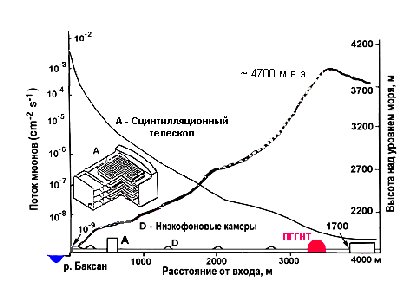
The gallium-germanium neutrino telescope (GGNT) is located in a specially built deep underground laboratory at the Baksan Neutrino Observatory of the INR RAS and is designed to measure the flux of solar neutrinos. Measurements of the solar neutrino flux make it possible to obtain unique information both on the occurrence of thermonuclear reactions in the central regions of the Sun and on new properties of neutrinos. GGNT is one of the deepest underground laboratories in the world. Since 1986, research has been carried out at the Gallium-Germanium Neutrino Telescope of the BNO INR RAS as part of the Russian-American SAGE experiment. The underground complex of the GGNT laboratory is located at a distance of 3.5 km from the entrance of the horizontal tunnel leading into Mount Andyrchi. The main room of the laboratory is an experimental hall, 60 m long, 10 m wide and 12 m high. |
||||||||||
|
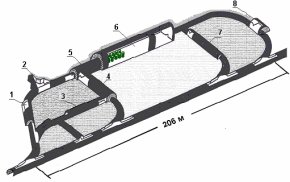 Scheme of underground workings of the GGNT laboratory. Scheme of underground workings of the GGNT laboratory.1,2,5,7,8 - auxiliary premises; 3 - electrical substation room; 4 - air conditioning room; 6 - GGNT reactor hall |
|||||||||
|
The rocks above the laboratory create protection from cosmic ray muons corresponding to 4700 m of water equivalent, and weaken the muon flux by a factor of 107. The measured muon flux is (3.03 ± 0.10) x 10-9 (cm2 x s)-1. To reduce the neutron and gamma background from the surrounding rocks, the hall is lined with low-radioactive concrete 600 mm thick and steel sheet 6 mm thick. The flux of neutrons with energy > 1 MeV in the laboratory does not exceed 1.40 × 10⁻⁷ neutron × (cm2 × sec)-1. The underground complex also contains rooms for analytical chemistry, a system for recording 71Ge decays, and a low-background semiconductor Ge detector.
A number of rooms for auxiliary measurements are located in laboratory buildings located on the surface. Gallium-Germanium Neutrino Telescope
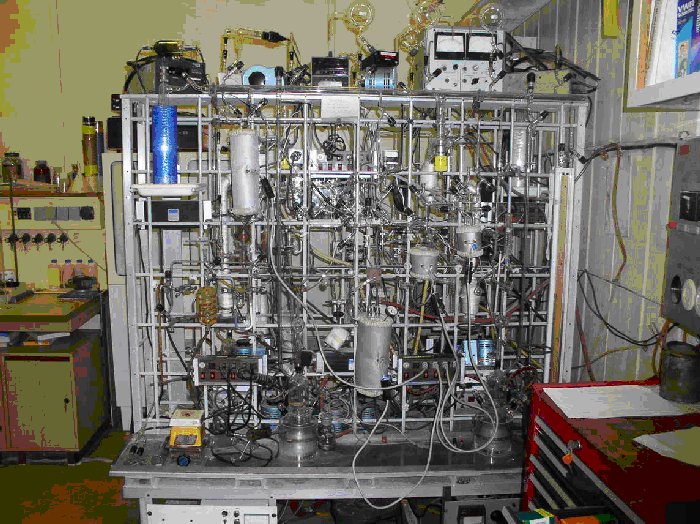
The operating principle of the telescope is based on the reaction of neutrino (ve) capture by the 71Ga nucleus with the formation of a 71Ge nucleus and an electron (e-): 71Ga (ve, e-) 71Ge (1) The telescope uses about 50 tons of molten gallium metal as a target, which is located in 7 chemical reactors. Gallium in reactors is contained at a temperature of ~310C (the melting point of gallium is 29.80C). The natural abundance of the gallium isotope 71Ga is 39.9%. With the expected neutrino flux from the Sun (6 × 10¹⁰ neutrinos cm-2 s-1), about 30 71Ge atoms are formed within a month in 50 tons of gallium metal. A unique technology was developed to extract single 71Ge atoms from 50 tons of gallium metal, which is one of the main technological processes of the telescope. The overall efficiency of extracting 71Ge atoms from a gallium target containing 5 × 1029 71Ga atoms is ~90%. From the extracted 71Ge, GeH4 (monogermane) gas is synthesized, which is the main component of the working gas mixture. The mixture is placed in a proportional counter (PS), which is used to record the decays of 71Ge atoms in the GGNT recording system. 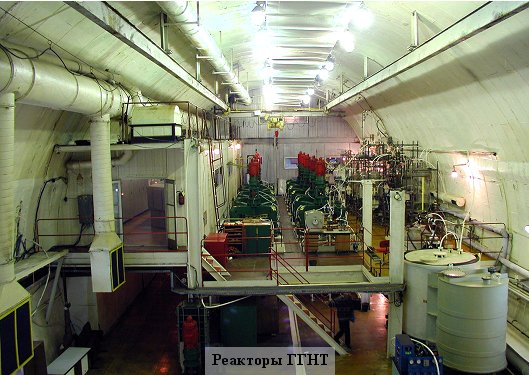 |
||||||||||
|
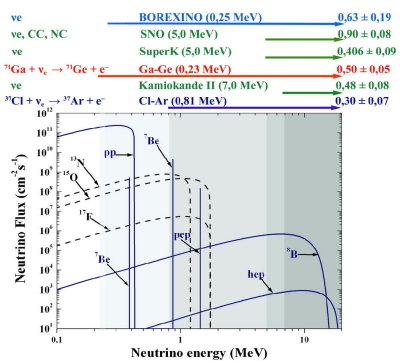
The advantage of this detection method, proposed in 1965 by Soviet scientist V.A. Kuzmin, is the low energy threshold of reaction (1), which is 0.233 MeV, which is significantly lower than the maximum neutrino energy from the pp reaction - 0.423 MeV. Thanks to this, the gallium neutrino telescope is able to detect neutrinos produced in this reaction, which makes the largest contribution to the solar neutrino flux. |
|||||||||
|
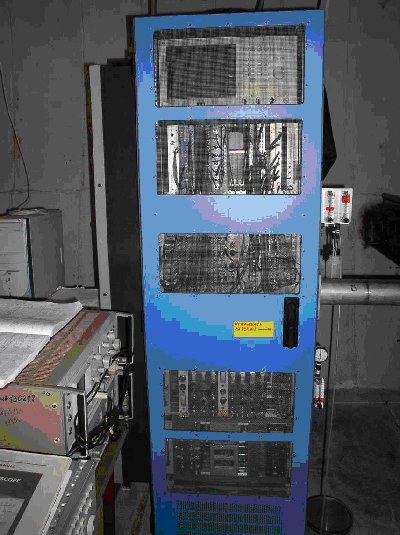
GGNT registration systemThe registration system is located in a specially designed room in an underground mine of the GGNT complex. Its external walls are lined with low-radioactive concrete 700 mm thick and steel sheet 10 mm thick. The internal walls of the room are lined with galvanized iron 1 mm thick for the purpose of shielding from radio interference. |
|||||||||
|
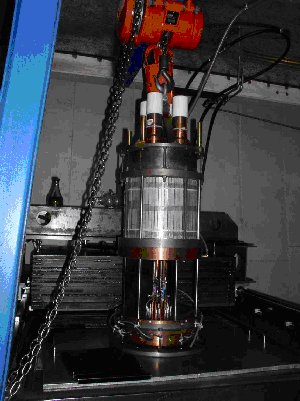
The GGNT registration system has 8 counting channels and a combined protection common to all substations, consisting of internal and external parts. The internal part of the protection includes a NaI(Tl) crystal enclosed in a copper shell. The crystal is viewed from above by four photomultipliers. In the lower part of the internal protection in the center, copper cone fasteners are evenly distributed around the circumference to fix eight substations in a vertical position. External passive protection consists of three layers of low-radioactive materials. The system includes a 1 GHz digital oscilloscope, which is used to record the pulse shape from the PS. |
|||||||||
|
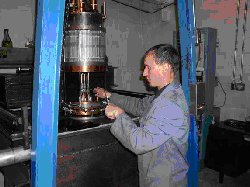
Registration of rare decays of 71Ge atoms in PS continues for ~5 months: 10 half-lives of 71Ge (11.4 days). Information about events in the PS is transmitted online via a fiber optic channel to the server of the local computer network LGGNT. |
 |
|||||||||
|
SAGE Experiment Results
The SAGE experiment was designed to measure the capture rate of solar neutrinos in the reaction 71Ga + νe → 71Ge + e- to provide information to address the neutrino deficit observed in the 37Cl experiment, which recorded only about one-third the capture rate predicted by the Standard Solar Model. A feature of the Ga experiment that distinguishes it from all other completed or currently operating solar neutrino experiments is its sensitivity to the proton-proton fusion reaction, p + p → d + e+ + νe, in which the overwhelming majority of solar energy is generated. Ga experiments provided the only direct measurement of the current rate of this reaction. SAGE began measuring in January 1990. The SAGE results showed for the first time the presence of a solar neutrino deficit over the entire neutrino energy range [Phys.Rev.Lett.67(1991), 3332; Phys Rev Lett 77 No.23 (1996) 4708; Phys.Rev.C.59 (1999) 2246; Phys.Rev.C60 (1999) 055801]. The result of measurements of the neutrino capture rate on 71Ga nuclei in the SAGE experiment for the period from January 1990 to August 2011 is: 65.4 ± 2.7(stat) ± 2.7(syst) SNU Using the results of other solar neutrino experiments and the theory of neutrino oscillations with a large mixing angle (LMA), SAGE obtained values for the flux pp of neutrinos (3.40 ± 0.46)*1010/(cm2*s), which have an electron flavor when they reach the Earth, and the total flux pp neutrino (6.0 ± 0.8)*1010/(cm2*s). The latter value is in good agreement with the SSM predictions of 5.97 ± 0.04 (high heavy element content) and 6.04 ± 0.03 (low heavy element content), both values in units 1010Vе/(cm2*s). The gallium solar neutrino experiments thus provided direct evidence of the validity of the Standard Solar Model and the LMA solution for solar neutrino oscillations and showed that the vast majority of solar neutrinos arriving on Earth are low-energy neutrinos from the proton-proton reaction. To clarify the reasons for the unexpectedly low rate of neutrino capture by Ga in experiments with artificial sources, we have developed a design for a new experiment with a high-intensity neutrino source and an optimized Ga target geometry. The SAGE experiment continues to measure the flux of solar neutrinos on a gallium target and to date remains the only experiment that measures the flux of low-energy pp neutrinos. By continuing to monitor the solar neutrino flux, we will increase statistical precision and reduce systematic uncertainties. In our calculations, we assumed that the cross section for neutrino capture to the two lower excited levels of 71Ge is equal to zero. This assumption follows from the results of four experiments with artificial neutrino sources 51Cr and 37Ar on the gallium detectors SAGE and GALLEX, in which the weighted average ratio of the measured and expected neutrino capture rates is 0.87±0.05 [Phys Rev C 73 (2006) 045805]. The assumption of a zero contribution from the two lower excited 71Ge levels to the neutrino capture cross section contradicts the standard interpretation of the Gamow-Teller (GT) factor measurements for these two 71Ge levels obtained using the (p,n)-scattering reaction. We have initiated an experiment at the Research Center for Nuclear Physics in Osaka, Japan (RCNP) to measure with high resolution the angular distributions in the reactions 71Ga(3He, t)71Ge and 69Ga(3He, t)69Ge, based on which it is expected to obtain the cross section value with good accuracy neutrino capture on gallium. However, the unexpectedly low results in experiments with artificial neutrino sources may have other explanations. One of them, currently being discussed in the press, is the possible transition of active electron neutrinos to sterile states. New measurements on gallium metal with an artificial high-intensity neutrino source (~2-3 MCi) and with an optimized gallium target geometry (2 irradiation zones) may provide an explanation for the unexpectedly low neutrino capture rate on gallium obtained in experiments with artificial neutrino sources [arXiv: 1006:2103[nucl-ex]]. Publications of the Russian American Gallium Experiment (SAGE)
Contact person:
Gavrin Vladimir Nikolaevich, Doctor of Physical and Mathematical Sciences, academician, gavrin@inr.ru tel.8(866)387-51-04, Tel 8(495)850-42-66 |
||||||||||