
Comprehensive study of ultra-high energy cosmic rays in joint Russian-Tajik astrophysical research in the Eastern Pamirs. Project PAMIR-XXI
A project for a comprehensive study of primary cosmic rays (PCR) and their interactions at mountain heights (project "Pamir-XXI", Eastern Pamir, 4260 m above sea level) was launched within the framework of the International Research Center "Pamir-XXI", established by the Government of Russia and Tajikistan.
In the coming years, the corresponding activities of the project participants will be carried out in accordance with the Practical Action Plan ("Road Map") for joint Russian-Tajik astrophysical research and the development of high-mountain test sites in the Eastern Pamirs for 2019-2022, developed by the Ministry of Education and Science of the Russian Federation in pursuance of the instructions of the 16th of the th meeting of the Intergovernmental Commission on Economic Cooperation between the Russian Federation and the Republic of Tajikistan dated March 20, 2019.
1. Introduction
In the middle of the 20th century, complex EAS installations became, in fact, the main tool for determining the energy spectrum of PCRs, their mass composition and anisotropy in the energy range E0 ~ 1 PeV and above. Such shower installations include systems of spatially separated detectors of various types used to study various components of EASs, namely: ground-based charged particle detectors (for studying the electron-photon and muon components), underground charged particle detectors (for high-energy muons), central calorimeters (for high-energy hadrons in EAS trunks), optical detectors of various types (for recording Cherenkov radiation or fluorescent light), radio detectors, etc.
Initially, complex EAS installations were aimed both at studying the astrophysical aspects of PCRs and their characteristics, and at studying high-energy hadronic interactions. However, for some time it seemed that the emergence of very high-energy accelerator-colliders (SPS, Tevatron, RHIC, LHC) would lead to the cessation of research at EAS facilities in the second direction, leaving only the first of these directions for CR. That is why most of the latest EAS experiments were planned based on the assumption that the second problem had been solved, which began to be considered as a unique prerogative of collider experiments. As a result, EAS installations put into operation in recent decades were built only to study the problem of the primary spectrum, composition and anisotropy of PCR, leaving interaction problems unattended. However, it is now clear that the very design of collider experiments and the features of their design (for example, the rather large transverse dimensions of the accelerator tubes) do not allow experimenters to study some important features of the interactions of ultra-high-energy hadrons associated with the production of particles in the forward cone ('forward physics'), in in particular, to study the characteristics of secondary particles with great speed. Thus, the leading particles remain outside the kinematic region of phase space, which is called the fragmentation region of the incident particle, accessible to observation using colliders. As a result, it turned out that the only way today to study the properties of the most energetic secondary particles in nuclear interactions at ultra-high energies is to conduct experiments with cosmic rays on a stationary, but not too thick target of the air layer above the installation (for example, experiments with REK or REK +EAS at mountain heights) or on a stationary thick target of the central calorimeter at relatively lower energies. Both of these methods, used in cosmic ray experiments, make it possible to study the behavior of secondary hadrons produced in the forward cone.
The need for this kind of research is also supported by a number of new phenomena (or unusual types of events) that were observed in experiments with X-ray emulsion chambers (XECs) exposed to cosmic rays at mountain heights and in the stratosphere. In particular, these experiments observed the unexpected phenomenon of coplanar production of the most energetic particles in the composition of EAS trunks, which is not described by conventional models of hadronic interactions. For the first time, corresponding events, characterized by a linear arrangement of particles on the target diagram, were discovered in the Pamirs back in the 80s of the last century.
Currently, in high-energy physics, several phenomenological models of hadronic interactions are used, which are quite different from each other, each of which claims to adequately describe hadron-nuclear interactions at ultra-high energies. Their difference leads to significantly different conclusions about the nature of the spectral breaks and the mass composition of PCR (Figs. 1 and 2), which are obtained as a result of solving the inverse problem (reconstruction of the spectral parameters and composition of PCR from the observed characteristics of EAS).
In the middle of the 20th century, complex EAS installations became, in fact, the main tool for determining the energy spectrum of PCRs, their mass composition and anisotropy in the energy range E0 ~ 1 PeV and above. Such shower installations include systems of spatially separated detectors of various types used to study various components of EASs, namely: ground-based charged particle detectors (for studying the electron-photon and muon components), underground charged particle detectors (for high-energy muons), central calorimeters (for high-energy hadrons in EAS trunks), optical detectors of various types (for recording Cherenkov radiation or fluorescent light), radio detectors, etc.
Initially, complex EAS installations were aimed both at studying the astrophysical aspects of PCRs and their characteristics, and at studying high-energy hadronic interactions. However, for some time it seemed that the emergence of very high-energy accelerator-colliders (SPS, Tevatron, RHIC, LHC) would lead to the cessation of research at EAS facilities in the second direction, leaving only the first of these directions for CR. That is why most of the latest EAS experiments were planned based on the assumption that the second problem had been solved, which began to be considered as a unique prerogative of collider experiments. As a result, EAS installations put into operation in recent decades were built only to study the problem of the primary spectrum, composition and anisotropy of PCR, leaving interaction problems unattended. However, it is now clear that the very design of collider experiments and the features of their design (for example, the rather large transverse dimensions of the accelerator tubes) do not allow experimenters to study some important features of the interactions of ultra-high-energy hadrons associated with the production of particles in the forward cone ('forward physics'), in in particular, to study the characteristics of secondary particles with great speed. Thus, the leading particles remain outside the kinematic region of phase space, which is called the fragmentation region of the incident particle, accessible to observation using colliders. As a result, it turned out that the only way today to study the properties of the most energetic secondary particles in nuclear interactions at ultra-high energies is to conduct experiments with cosmic rays on a stationary, but not too thick target of the air layer above the installation (for example, experiments with REK or REK +EAS at mountain heights) or on a stationary thick target of the central calorimeter at relatively lower energies. Both of these methods, used in cosmic ray experiments, make it possible to study the behavior of secondary hadrons produced in the forward cone.
The need for this kind of research is also supported by a number of new phenomena (or unusual types of events) that were observed in experiments with X-ray emulsion chambers (XECs) exposed to cosmic rays at mountain heights and in the stratosphere. In particular, these experiments observed the unexpected phenomenon of coplanar production of the most energetic particles in the composition of EAS trunks, which is not described by conventional models of hadronic interactions. For the first time, corresponding events, characterized by a linear arrangement of particles on the target diagram, were discovered in the Pamirs back in the 80s of the last century.
Currently, in high-energy physics, several phenomenological models of hadronic interactions are used, which are quite different from each other, each of which claims to adequately describe hadron-nuclear interactions at ultra-high energies. Their difference leads to significantly different conclusions about the nature of the spectral breaks and the mass composition of PCR (Figs. 1 and 2), which are obtained as a result of solving the inverse problem (reconstruction of the spectral parameters and composition of PCR from the observed characteristics of EAS).
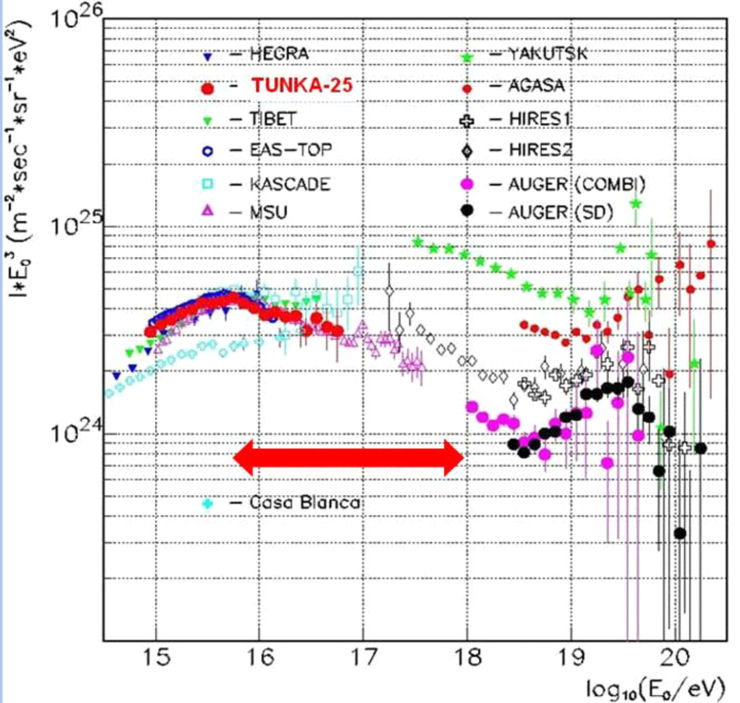
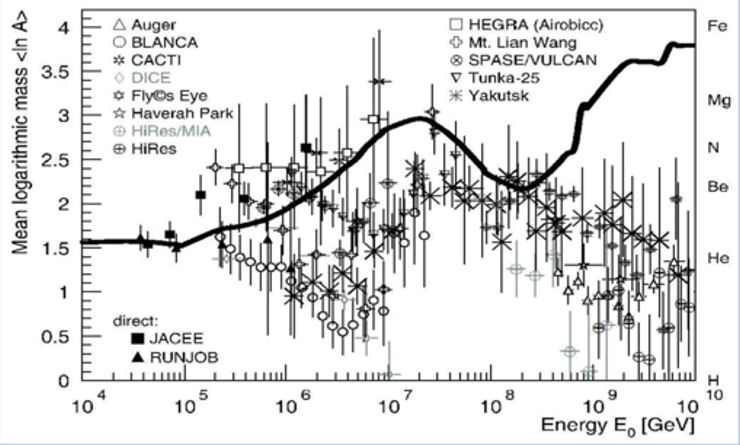
Since the problem of PCR composition at ultra-high energies is far from being solved, the original set of goals set for complex EAS installations is still relevant. However, now it can be solved more effectively if we rely not only on a higher modern level of understanding of the problem, but also on the progress of recent decades in the field of experimental and computer technologies, which makes it possible to apply new methods for processing and analyzing experimental data. It is precisely this approach that is incorporated into the new Pamir-XXI project, which, as we see it, is capable of significantly advancing the solution of classical problems (studying PRL parameters and constructing an interaction model) still facing complex EAS installations.Another goal of the new installation is to study diffuse gamma radiation of ultra-high energy (Eγ>30 TeV) in the entire accessible hemisphere (Northern Hemisphere), as well as to search for point γ-sources for their subsequent more detailed study using stereoscopic APRT systems (such as HESS, VERITAS, CTA, AGIS, etc.).
2. Composition and features of the new integrated EAS installation
It is proposed to create in the mountains of the Eastern Pamirs at an altitude of 4260 m above sea level. complex new generation EAS installation with an area of ~ 1 km2 (Pamir-XXI), the design of which is based on two original approaches:
• new technology for detecting Cherenkov light from EASs, using:
a) a stereoscopic system of several (optimally four) optical raster telescopes with a mirror area of about 4 m2, a viewing angle of at least 30° and a pixel size of ~0.8°, which will be able to distinguish EASs initiated by different (by mass) groups of primary nuclei,
b) a network of fast wide-angle optical detectors (40 - 50°) with a grid step size of 25 m, which can determine the direction of arrival of EAS with high accuracy (~ 0.1°), as well as the position of the EAS axis and the energy of the primary particle;
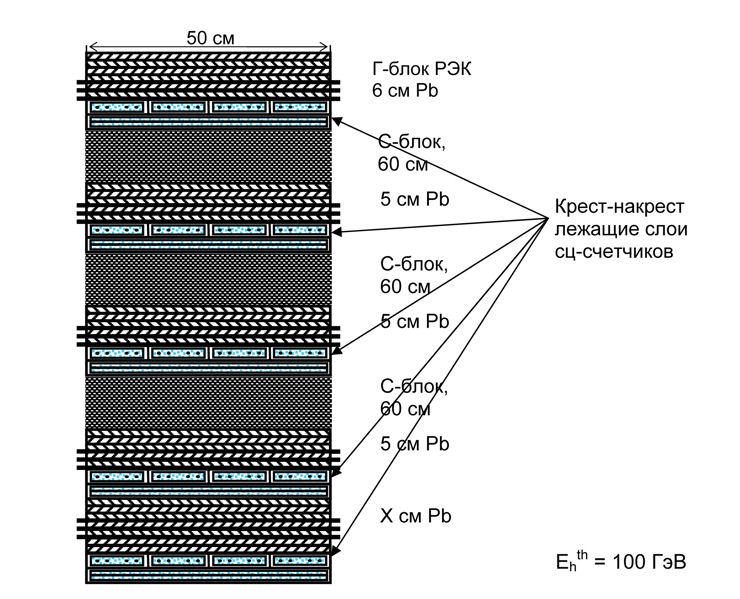
• a new type of central hybrid calorimeter in combination with an X-ray emulsion chamber (XEC), which makes it possible to study the characteristics of individual high-energy hadrons as part of EAS tables, and a push installation, represented by two layers of extended narrow scintillation counters, located crosswise and providing the possibility of effective comparison of two types of events : EAS events recorded in real time, and REC events continuously heated in passive mode during the entire period of REC exposure; The sensitive elements of the hadron calorimeter itself will be several paired layers of the same extended (4-meter) plastic scintillation counters with fiber-optic signal pickup.
The ground-based shower system of charged particles of the Pamir-XXI installation will have a traditional design, optimized for observing EAS at the installation altitude (606 g/cm2). Since this height approximately corresponds to the maximum development of a proton shower in the atmosphere at an energy of E0 ~ 1015 eV, fluctuations associated with the development of the shower are minimal, which means that the shower parameters at this altitude level are maximally sensitive to the nature of the primary particle.
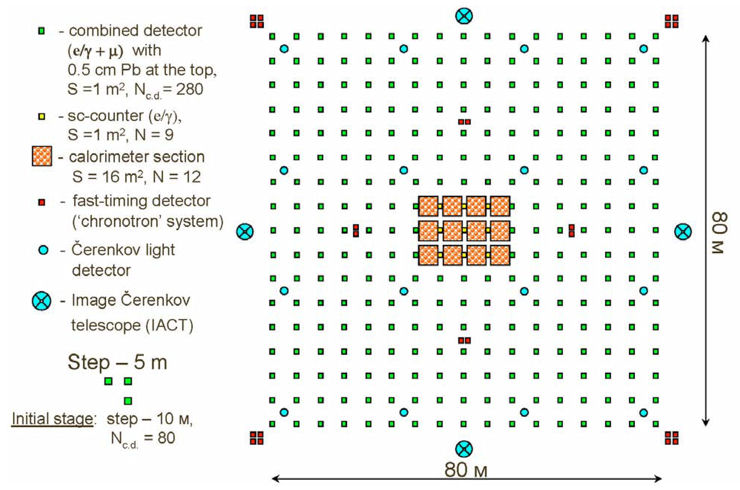
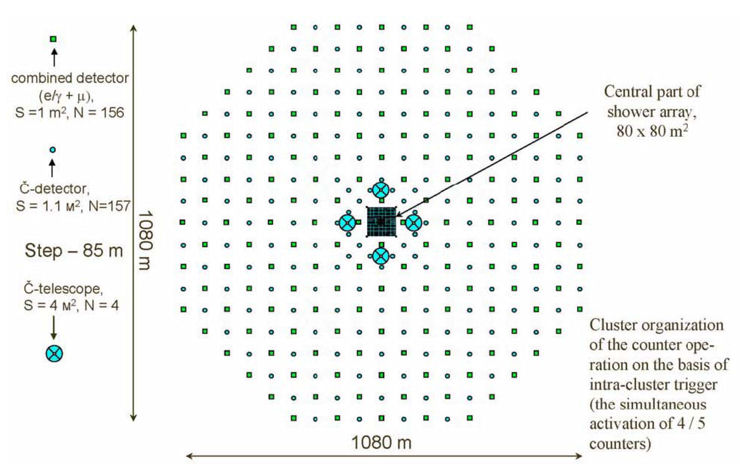
The general layout of the detectors as part of the Pamir-XXI installation is shown in Fig. 3 and 4.
The Pamir-XXI installation includes:
• a deep (~ 3.5 λint) lead-carbon calorimeter with a total area of 192 m2 located in the center of the linear installation in combination with an REC and a push installation, made in the form of two continuous layers of cross-lying plastic scintillation counters with fiber-optic signal pickup (Fig. 5) ;
• two concentric systems (arrays) of shower detectors around the hadronic hybrid calorimeter: one dense (with a step of 5 m) with an area of 80 x 80 m2 and with a high detection threshold (the central part of the storm installation, Fig. 3), and the other rarer (with a step 85 m) with an area of 1 × 1 km2 and with a low detection threshold (peripheral part of the storm installation, Fig. 4), providing the opportunity to study PCR in a wide range of primary energies E0 ≈ 3·1013 - 1018 eV (Fig. 4);
• a fast timing system (“chronotron”), consisting of 8 scintillation points and making it possible to determine the angles of arrival of EAS by the delay of arrival of the EAS front at different points of the registration system;
• a matrix of 157 fast wide-angle (40-50°) Cherenkov detectors (BH), located throughout the installation area of ~ 1 km2, to determine the shape and amplitude of the spatial distribution dQ/dR of the EAS BL, as well as the characteristics of the EAS BL pulse shape, i.e. e., time distributions dQ/dT and d2Q/dRdT; the pitch in the central part of the matrix is 25 m (Fig. 3), while on the periphery it is 85 m (Fig. 4); fast black holes will either be made in the form of wide-angle photomultipliers of the EMI 9350 type with a hemispherical photocathode with a diameter of 20 cm, or consist of mirrors with a diameter of ~ 1.2 m with matrices of 19 photomultipliers placed in the focal plane of these mirrors;
• four wide-angle atmospheric Cherenkov raster telescopes with a field of view of at least 30° and a PMT mosaic pixel size of 0.6 - 0.8° to determine the spatial-angular distribution d3Q/dRdθxdθy of individual EAS BCs;
• lidar for monitoring the quality of the night atmosphere.
The use of different methods for detecting EASs in one experiment and a wide range of studied primary energies, partially overlapping the region of “direct measurements” on balloons and satellites, opens up the possibility of mutual calibration of different experiments, which often obtain significantly different conclusions about the parameters of PCR in the region of primary energies of interest to us.

3. Start of the project
In 2012 - 13 As part of the Pamir-XXI project, large-scale work was carried out in preparation for the creation of a new complex installation:
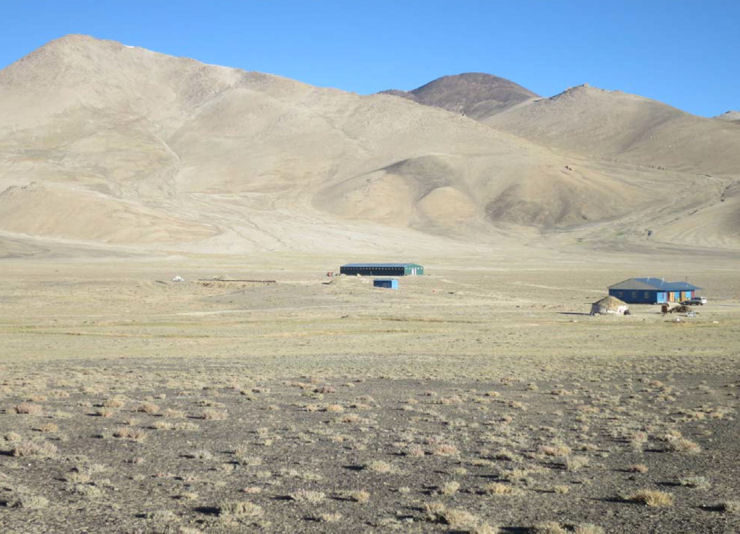
• in the Eastern Pamirs at an altitude of 4260 m above sea level. a flat, almost horizontal site was found (Fig. 6) for deploying an installation with an area of ~ 1 km2 and arranging a new experimental site on it, the natural conditions of which (primarily the astroclimate) are ideal for conducting Cherenkov observations of EASs and year-round work;
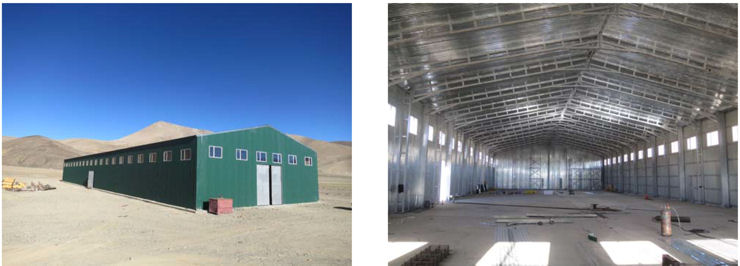
• a road suitable for the delivery of large-sized cargo has been built to the new landfill; Comfortable residential premises with an area of ~ 140 m2 were built at the test site, adapted for year-round residence of personnel and specialists (Fig. 6); an insulated single-span all-metal hangar with an area of 60 × 20 m2 was erected (Fig. 8), which will house the central calorimeter, as well as points for collecting and primary processing of experimental data; premises and foundations have been prepared for a hybrid power plant and a diesel generator with a total capacity of 56 kW (Fig. 7);
• a hybrid power plant with a capacity of 6 wind generators (6 × 5 kW) and 80 solar modules (80 × 0.2 kW), as well as a backup diesel generator with a capacity of 10 kW, was purchased and delivered to the expedition base located in Osh. ;
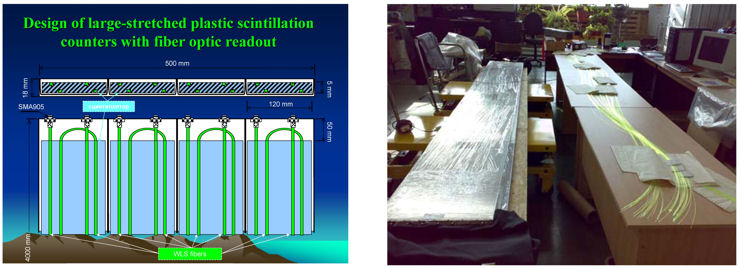
• within the framework of cooperation with IHEP (Protvino), the first 18 units were developed, manufactured and tested at the TShVNS FIAN. extended plastic scintillation modules measuring 400 × 50 cm2, consisting of 4 independent scintillation counters with fiber-optic signal acquisition, which are planned to be used to create a hybrid hadronic calorimeter (Fig. 9);
• the ECSim software package [1] has been upgraded to simulate the response of a multilayer hybrid detector (REC, calorimeter, system of ground-based charged particle detectors, etc.) by including the FANSY 1.0 model of hadron-nucleus interactions [2], which describes data from X-ray emulsion experiments;
• extensive calculations were carried out to simulate the response of the central hybrid calorimeter, which made it possible to refine the design of the calorimeter in order to improve the spatial resolution of EAS trunks and the efficiency of comparing EAS trunks and EEC events; calculations confirmed the required resolution of the push installation, represented by a pair of criss-crossed solid layers of scintillation counters, which is several centimeters (Fig. 10).
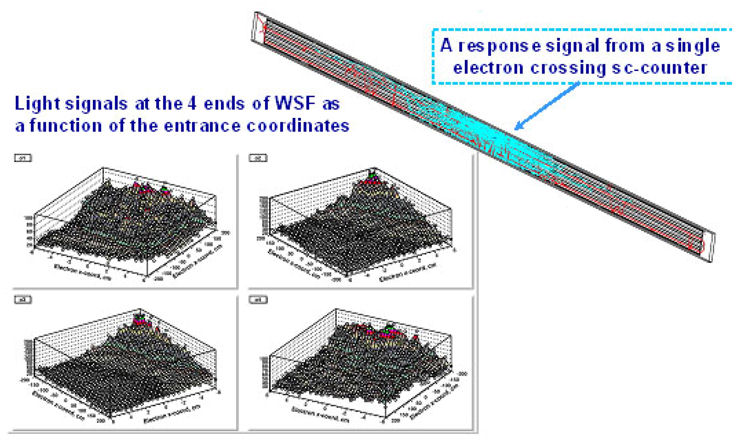
Currently, intensive work is being carried out to model the response and select the most optimal configuration of the shower system of the new EAS installation, consisting of a system of ground-based charged particle detectors and a system of optical detectors of the ChS. The next stage of this work will be the physical design of this type of detector.
4. Strategy for using the EAS shower detector
To study the energy spectrum and mass composition of PCRs, it is necessary to determine the direction of arrival, energy, and type of the primary particle by measuring various characteristics of EASs. To determine all these parameters of the primary particle, only spatial, angular and temporal distributions of EAS BC can be used. All these characteristics carry information about the development of the shower, including data on its main longitudinal characteristics, i.e. about its cascading curve.
Over the past 30 years, solving the problem of the mass composition of PCR has invariably been associated with the simultaneous assessment of the primary energy E0 and the depth of the shower development maximum Xmax, because, according to the behavior of the average cascade curve, the position of its maximum at a known energy value E0 is mainly determined by the mass of the primary particle.
This logic seems quite natural, but in fact it has serious flaws:
1) the cascade curve and, therefore, the position of its maximum, as a rule, are not directly observable quantities (with the exception of the EAS cascade curve scanned by the fluorescence method, which has a high energy threshold of ~ 1017 eV);
2) individual EAS cascade curves with the same values of the primary parameters can vary greatly due to fluctuations in the development of the shower; Often the positions of the maxima of cascades initiated by primary particles with the same mass are close to those generated by particles with significantly different masses.
The first circumstance means that Xmax plays the role of an intermediate variable for the transition to the mass A0 of the primary particle, which inevitably leads to the loss of information about A0, since the A0-Xmax dependence is not rigid. The second circumstance indicates that Xmax is insufficiently informative and forces us to look for more informative measures.
The current state of the problem of mass composition requires a serious rethinking of their properties, which can be formulated as follows:
• it is necessary to collect much more data for each event than is currently being done, i.e., the EAS storm installation must be more complex, more specialized, and also carefully calibrated;
• EAS parameters that are most sensitive to A0 should be measured;
• when processing observational data, it is necessary to extract information about the mass of the primary particle only using direct connections between observed quantities and A0 without using intermediate variables (for example, Xmax);
• methodological uncertainties must be carefully reviewed and transparent to cross-checks.
The two most promising characteristics of EAS CSs from the point of view of the mass composition of PCRs are spatial distributions (SD) and spatial angular distributions (SAD). The first has been known as a measure of the longitudinal development of EAS for more than 30 years and is currently used in the SPHERE-2 experiment [3]. The possibilities for the spatial-angular distribution of EAS CS (EAS) turn out to be much richer. By PUR we mean a set of angular Cherenkov raster images of a shower, obtained using several telescopes located at different distances from the shower axis. PUR is a more differential characteristic of an EAS CS than PR, so we have the right to expect that it contains more meaningful information about the mass of the primary particle [4].
Since the duty cycle of Cherenkov detectors is only approximately 10% of the total observation time, some new characteristics of charged particles that are sensitive to the mass composition of PCR must be found. For this purpose, the results of detailed modeling of the entire experiment should be used, in which, along with ES detectors, storm systems of ground-based charged particle detectors will be used. Simulation of the simultaneous operation of two types of detectors will help solve this problem.
5. Possibilities of a new complex installation.
Our calculations and estimates obtained allow us to conclude that the Pamir-XXI installation will have the following characteristics and capabilities:
• range of primary energies studied E0 ≈ 3·1013 - 1018 eV;
• uncertainty for primary energy δE0/E0≈ 15%;
• accuracy of determining the direction of particle arrival - no worse than 0.1°;
• accuracy of determining the position of the shower axis - no worse than 1 m;
• the error in the separation of primary protons/nitrogen nuclei will be 10% based on the results of observations, and in the separation of primary nitrogen nuclei/iron nuclei the error will also not exceed 10% in review mode;
• efficiency of selection of light nuclei (protons, protons+helium nuclei, ...): when selecting at least 30% of light nuclei, the admixture of other nuclei will be no more than 1% of their total number (i.e. 99% of heavier nuclei will be suppressed);
• selection of ultra-high-energy gamma rays will make it possible to preserve about 30% of true gamma quanta and suppress at least 99% of the primary nuclei that make up the background;
• the structure of the central hybrid calorimeter will make it possible to study the region of hadron fragmentation in hadron-nucleus interactions at energies E0>PeV (√s>2 TeV) and obtain additional information in relation to experimental data at the LHC.
6. Conclusion
The project "Pamir-XXI" has been developed for the study of PCRs in the energy range E0 = 30 ÷ 106 TeV, which provides for the creation in the mountains of the Eastern Pamirs at an altitude of 4260 m above sea level of a complex new generation EAS installation with an effective area of ~ 1 km2.
At the initial stage of its implementation
• the necessary infrastructure for a new high-mountain test site has been created for the deployment of a future installation on it;
• calculations are carried out for detailed modeling of the experiment and the response of individual detectors included in the installation in order to optimize the parameters and configuration of the installation;
• the design of individual components (detectors) of the installation is being developed and debugged. The implementation of the Pamir-XXI project will make it possible to create a unique and competitive world-class experimental facility that will restore the leading position of domestic science in the field of astrophysics of ultra-high energy particles.
Literature
[1] M.G. Kogan, A.S. Borisov, V.I. Galkin et al., Proc. 31st ICRC, Lodz (2009) ICRC1213.
[2] R.A. Mukhamedshin, Eur.Phys.J. C 60 (2009) 345
[3] A.M. Anokhina, R.A. Antonov , E.A. Bonvech et al., Bull. Lebedev Phys. Inst. 36 (2009) 146.
[4] V.I. Galkin and T.A. Dzhatdoev. On the Sensitivity of the Spatial-Angular Distribution of the Cherenkov Light in Extensive Air Showers to the Mass Composition of Primary Cosmic Rays with Energies of 1015 - 1016 eV, Moscow University Physics Bulletin 65 (2010) No. 3, pp. 195-202
Контактная персона: Мухамедшин Рауф Адгамович, e-mail: rauf_m@mail.ru, тел. +7 903-212-34-88