
Study of the structure of the central part of extensive air showers, study of variations and anisotropy of cosmic rays, ultra-high-energy gamma astronomy on the installations "COVER" and "COVER-2" BNO
INSTALLATION "CARPET"
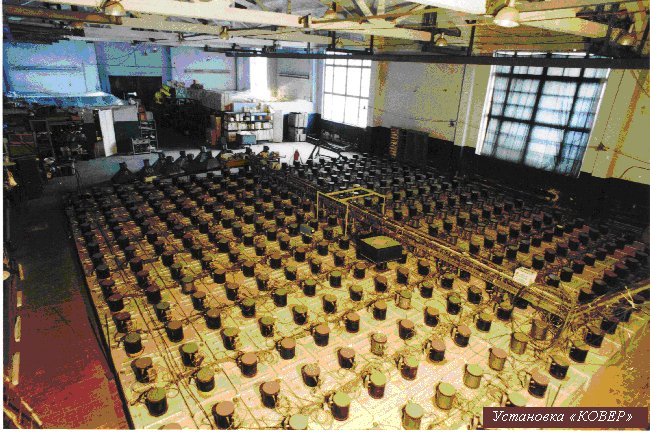
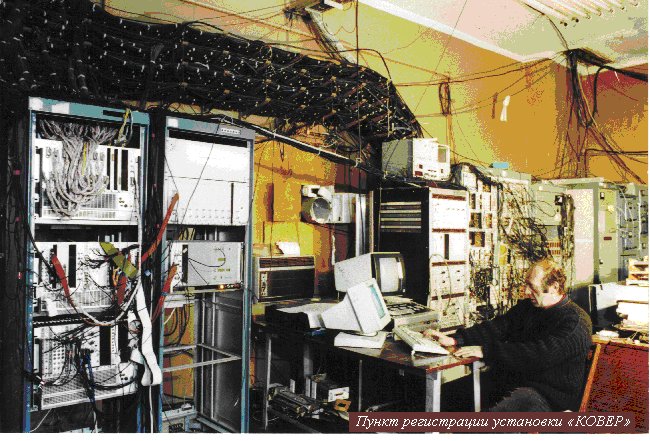
The COVER installation, which began operation in 1973, is designed to study the hard component of cosmic rays and extensive atmospheric showers, and has a continuous recording area of 200 m2. The central part of the installation and six remote points with an area of 9 square meters. m. are composed of the same standard liquid scintillation detectors as the underground scintillation telescope.
Main areas of research
- study of the structure of the central part of extensive air showers.
- Analysis of the events made it possible to interpret subbarrels in multi-barrel showers as a consequence of the generation of jets of particles with large transverse momenta and to estimate the cross section of this process in hadron-hadron interactions at an energy in the center of mass system √S ~ 500 GeV. The result of this experiment, which confirmed the predictions of quantum chromodynamics for the first time, was published earlier than the corresponding cross section measured at the SPS collider at CERN.
- study of cosmic ray variations
- The enormous counting rate of single cosmic ray muons allows for high statistical accuracy over short time intervals (0.03% per 4 minutes). A new type of sporadic variations with a short characteristic time associated with meteorological effects has been discovered - a strong correlation with the magnitude of the electric field in the atmosphere (observed only during a thunderstorm).
- Perhaps the most interesting of the sporadic changes in cosmic ray intensity is the gigantic increase during the powerful solar flare of September 29, 1989. For the first time in this event, the presence of particles of solar origin with an energy of at least up to 1010 eV was observed, and the most striking data were obtained precisely at the COVER installation.
- study of cosmic ray anisotropy
- The obtained cosmic ray anisotropy value at 1013 eV is (0.057 ± 0.005)%.
- ultra-high energy gamma-ray astronomy
- Atmospheric showers with energies greater than 1014 eV are continuously recorded. The most interesting result obtained to date is the registration of a flare from the Crab Nebula on February 23, 1989. Data on this outbreak, first published by the group working at the COVER installation, were later confirmed at the Collar Gold Fields in India and Top EAS in Gran Sasso (Italy).
INSTALLATION "CARPET-2"
Currently, work has been completed on the creation of part of the underground muon detector "COVER-2", intended for joint operation with the KOVER installation. This detector uses plastic scintillation detectors (175 pcs), with an area of 1 sq.m. every.
Basic installation parameters:
- continuous registration area 175 sq.m.
- the threshold energy for detected muons is 1 GeV;
- The sensitivity of the installation is greater than 0.004 particles/m2.
- The dependence of the average number of muons detected in the MMD (Nμ ) with energy E ≥ 1 GeV on the total number of shower particles (Ne) recorded by the COVER installation is obtained, approximated in the form:
- Nμ ~ Neα, α =0.8
- Analysis of information from the muon detector, when working together with the COVER installation, will significantly increase the sensitivity of the experiment to search for local sources of ultra-high-energy gamma quanta; conduct research on the chemical composition of primary cosmic rays with E ≥ 1014 eV; study variations of muons with energies greater than 1 GeV.
- The PST laboratory employs 52 people, of which 14 are scientists. Research results are regularly reported at Russian and International conferences, published in Russian and international periodicals; Some of the work is supported by the Russian Foundation for Basic Research.
 Contact person:
Petkov Valery Borisovich, Doctor of Physical and Mathematical Sciences vpetkov@inr.ru 8(866)387-51-37 fax 8(866)3875-205