
Radiation complexes based on LUE 10/20 and LUE5 for testing technologies for sterilization of medical instruments and medicines, as well as customs inspection techniques for detecting fissile and explosive substances.
The electrophysical installation of the Institute for Nuclear Research with a linear electron accelerator LUE 8-5 for an energy of 8 MeV with a beam power of up to 5 kW has been in operation since 1984. The construction of this installation was carried out by the team of the laboratory of photonuclear reactions in collaboration with the D.V. Efremov NIIEFA , who developed and manufactured the equipment for the LUE 8-5 installation. During the operation of the accelerator, the laboratory made a significant number of improvements, created new magneto-optical elements and units of the electron beam transportation system and equipment for the monitoring and control system of electron beam parameters.
As a result of further modernization, a specialized technological section was created in the Laboratory of Photonuclear Reactions of the INR, which provides radiation treatment of industrial batches of medical products in original packaging in order to ensure their sterility with high reliability. In addition, the installation with the LUE 8-5 accelerator has been used quite intensively all this time, both in methodological work for the preparation and adjustment of various experimental equipment, and in collaboration with third-party organizations - to solve numerous applied problems.
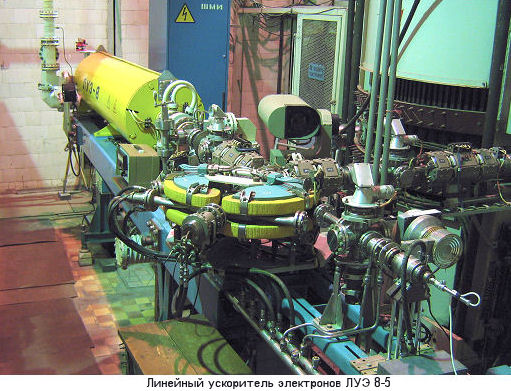
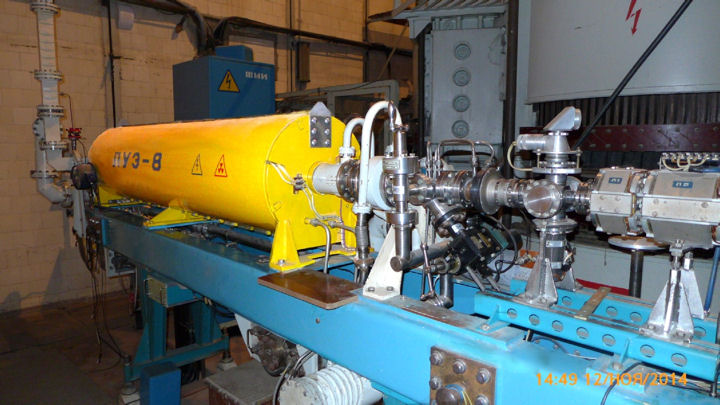
Energy of accelerated electrons, MeV up to 8
Beam power, kW up to 5
Repetition frequency, s-1 to 500
Pulse duration, µs 3
Among the wide range of applied works carried out at the accelerator, the following can be mentioned.
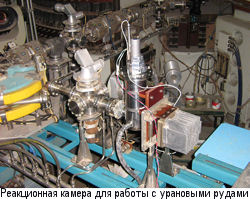
Development of hydrometallurgical technologies for processing new types of complex uranium raw materials.
Within the framework of the State Contract between VNIIKhT and Rosatom of the Russian Federation “R&D complex for the creation of effective hydrometallurgical technologies for processing new types of complex uranium raw materials to ensure the safe and sustainable development of nuclear energy in the Russian Federation”, together with VNIIKhT, work was organized at this accelerator to develop radiochemical methods for extracting uranium from difficult-to-open ore raw materials. Promising results have been obtained and the work is scheduled to continue.
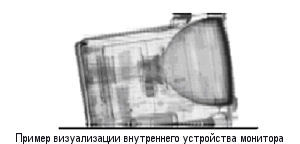
Application of high-current pulsed electron accelerators for the detection of hidden fissile substances.
The work carried out jointly with INTROSCAN LLC shows the possibility of using pulsed electron accelerators to detect and identify fissile substances hidden behind masking protection. The achieved results ensured the participation of INR in research and development work on the creation of inspection and inspection complexes based on accelerator technology in contact with the Federal Agency for the Development of the State Border of the Russian Federation (Rosgranitsa), JSC "Defense Systems" and JSC "Design Bureau" Kuntsevo" It is planned to develop control systems for large cargo and vehicles. The corresponding protocol of intent was signed by the INR management.
Creation of a reference installation for verification and calibration of radiation measuring and control instruments.
In cooperation with VNIIFTRI, the organization of an accelerator complex based on LUE-8-5 for calibration and standardization of reference measuring instruments is being discussed.
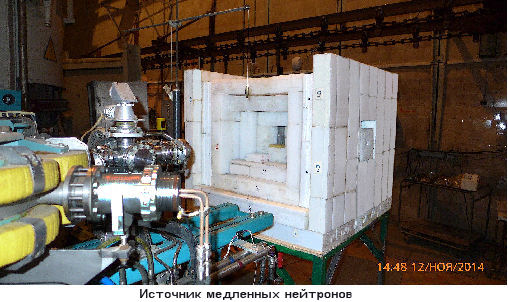
Creation of a source of slow neutrons.
Calculations were performed, a neutron source was assembled and installed on the W-Be accelerator beam according to the following scheme:
electron beam - W bremsstrahlung target - gamma ray beam - neutron-producing Be target - neutron moderator.
Studies and calculations of the source parameters were carried out in order to obtain the maximum thermal neutron flux density in the measuring cavity of the chamber (in the center of the moderator). According to the estimates obtained, the source will make it possible to carry out a wide range of tasks of neutron activation analysis. The source has both an internal cavity for irradiating samples with thermal neutrons and channels for removing thermal and fast neutrons from the source. Thus, using an extracted beam of thermal neutrons, together with the Lebedev Physical Institute, a research methodology for neutron diffraction is being developed, and other areas of research are being considered.
The use of various filters will make it possible to vary the spectrum of neutrons in the output channels; in particular, calculations show the possibility of forming a neutron flux at this installation with a spectrum similar to the spectra of neutrons produced in outer space, which will make it possible to solve a number of astrophysical problems here. Thus, on the basis of an accelerator and a W-Be neutron source, it is possible to carry out work with neutrons in a wide energy range - from thermal to fast.
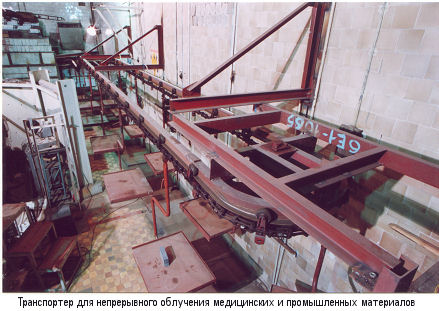
Sterilization of medical devices and materials.
A specific and very important area of work is the sterilization of medical devices and materials. Based on the LUE-8-5 accelerator as a source of radiation, a technological site was created for continuous processing of products on an industrial scale with full control of irradiation parameters.
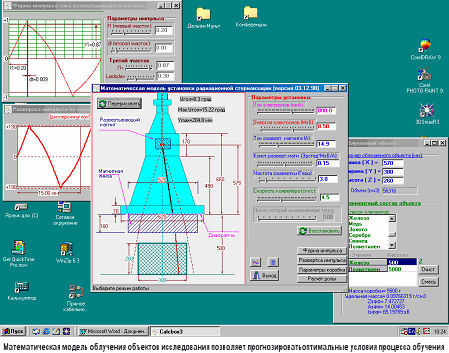
Studying the possibilities, features and prerequisites for creating industrial production of high-quality cements and concretes through electron-thermal processing of natural raw materials with accelerated electron beams.
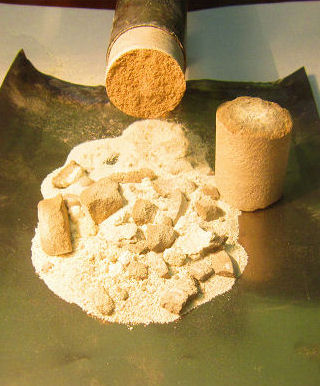
Preliminary experiments on radiation destruction of natural limestone samples to a finely dispersed state after irradiation with electrons with an energy of 7 MeV.
Electron accelerators of the LUE-8-5 series developed by NIIEFA named after. D.V. Efremova are intended mainly for use in solving applied problems in the field of solid state physics, studying the radiation resistance of materials and radio components, processing various kinds of raw materials, materials and products for medical purposes, etc. They are successfully used in problems of activation analysis of various elements.
However, recent interest in studying photonuclear reactions near the threshold (at electron and photon energies below 10 MeV) has required the creation of electron beams with improved characteristics that meet the requirements of modern experiment. The following operating parameters have been achieved: beam energy is adjustable within 4 - 10 MeV, energy resolution (width at half maximum) - from 1% at currents up to 6 μA and 10% at maximum current values up to 300 μA, pulse repetition rate 300 1/s and pulse duration 3 μs.
High-resolution beams are obtained using a magnetic beam formation system with a beam rotation of 270°. At the operating radiation complex this year, a number of experiments have been carried out on the fission of actinide nuclei near the threshold, excitation of isomer nuclei in the pygmy resonance region, and measurement of electron-positron conversion for a number of nuclei near the threshold.
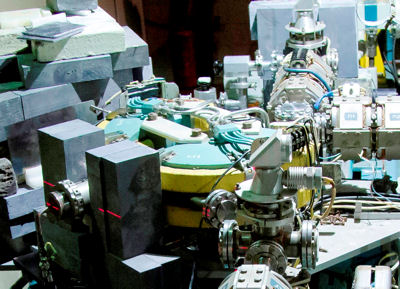
Magnetic spectrum analyzer of accelerated electrons (center).
Consists of two magnets, each of which rotates the beam by 135°.
After passing through two magnets, a beam rotated by 270° has an energy spectrum width of no worse than 1%.